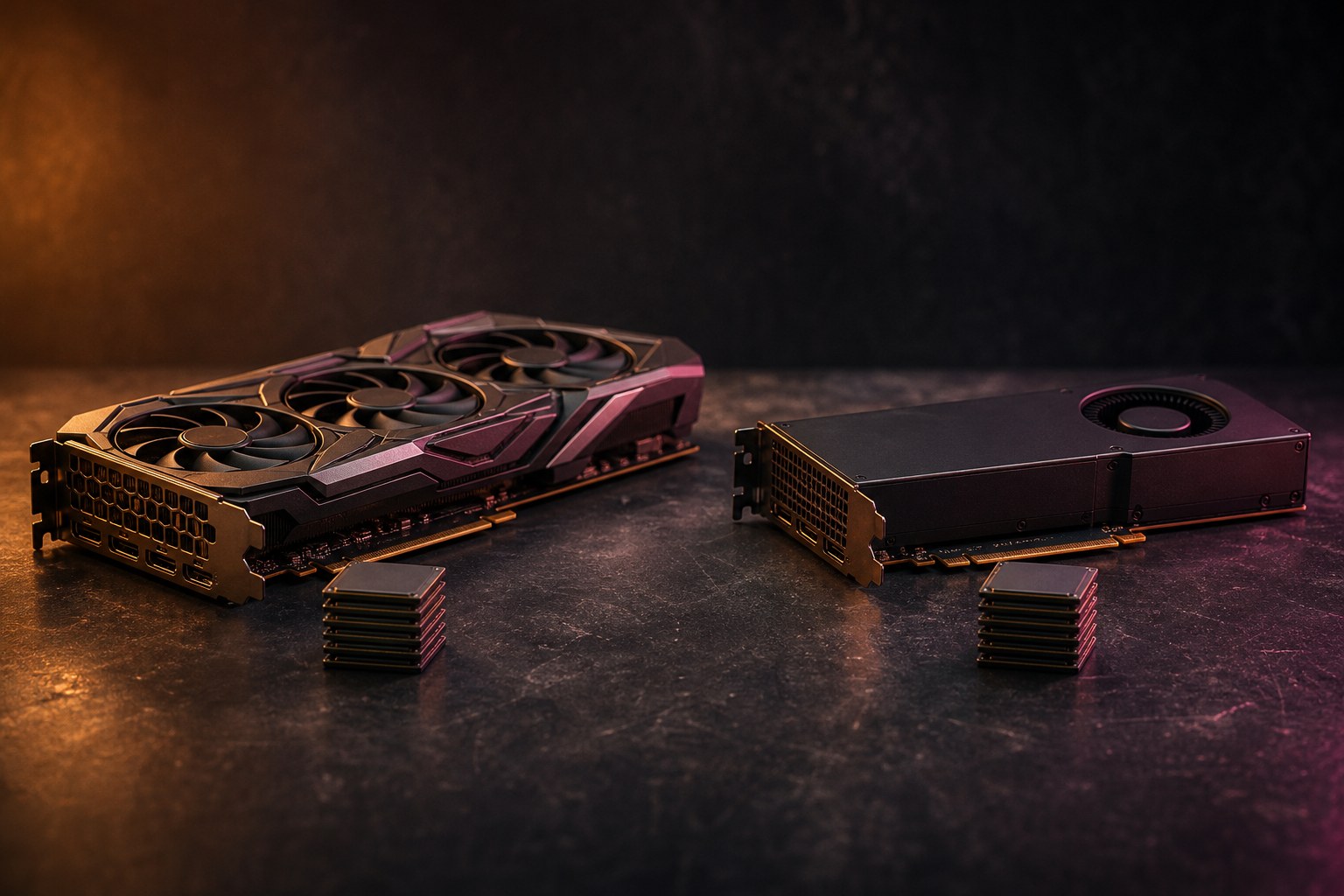
On 10 October, covering the rumour that NVIDIA was steering its top die away from the RTX 5090, we said the question that mattered was not whether a product name survived but whether 32 GB stays purchasable in a consumer card. For the video model we publish with, 32 GB is the amount that makes the work possible.
This weekend a post on r/LocalLLaMA put a price on one answer.
The card and the benchmark
The card is the Intel Arc Pro B70, a workstation card with 32 GB. The poster bought one last week for $1,299 from a board partner’s store on Amazon, against 5090s listed at $6,500 and up. They ran Qwen3.8-27B on both and reported, after tuning, about half the 5090’s generation speed and a third of its prefill speed, for about a fifth of the price.
Two details in that post deserve as much attention as the headline. Out of the box, in their words, it was really bad, and the half speed came only after several changes. And this is a language model benchmark. It tells you nothing yet about pictures or video.
The price is not stable either
The B70 launched at a suggested $949. On 24 October another poster reported a 30 percent jump in a day on Amazon and predicted the B70 would settle around $1,840. VideoCardz reported US listings up to $2,400 in late October. One person paid $1,299 last week. All of those are true at once, which is what a market looks like when everyone has worked out the same thing at the same time.
So the range is roughly $1,300 to $2,400 depending on the week and the seller. Still well under a 5090. Not the bargain it was in the summer.
What it means for image and video work
This is our lane, so this is where we were careful.
ComfyUI does support Intel Arc, through PyTorch’s XPU backend on the manual install. Puget Systems tested the B70 and found ComfyUI detected it with no patches, and a 15.6 GB image pipeline at 1024 by 1024 fit in memory and ran without offloading. Images on this card are a demonstrated thing. The ComfyUI desktop app, by contrast, still puts NVIDIA first, so the easy install path is not the one that works.
Video is where we found much less. In September a post on r/StableDiffusion described someone running MiniMax H3 as a real-time avatar across several B70s, which tells you it can be done by somebody determined. We could not find a published ComfyUI video benchmark on the card. No timings, no workflow, nothing we would be comfortable planning a purchase around.
For video, the software is the bigger cost. Video models in ComfyUI lean on custom nodes, attention kernels and quantised formats that are written and tested against NVIDIA first. Every one of those is a place a 32 GB Intel card could have the memory and still not run the workflow you wanted, or run it at a speed nobody has measured yet.
Where this leaves the question
32 GB at a price a person might pay does still exist. It just moved to a different badge, with a software bill attached that the price tag does not show.
If your work is language models, the trade in that post looks reasonable, provided you are willing to do the tuning. If your work is images, it is a real option with an awkward install. If your work is video, you would be among the first to find out, and better to know that before you buy than after.
We run on a 5090 we bought before any of this, so we have no Intel card to test. If that changes, the first thing we would publish is one H3 clip, start to finish, with the wall clock. Nobody has published that yet.
A daily note from our news radar. The week gets the full treatment in the DIY AI Brief every Monday.