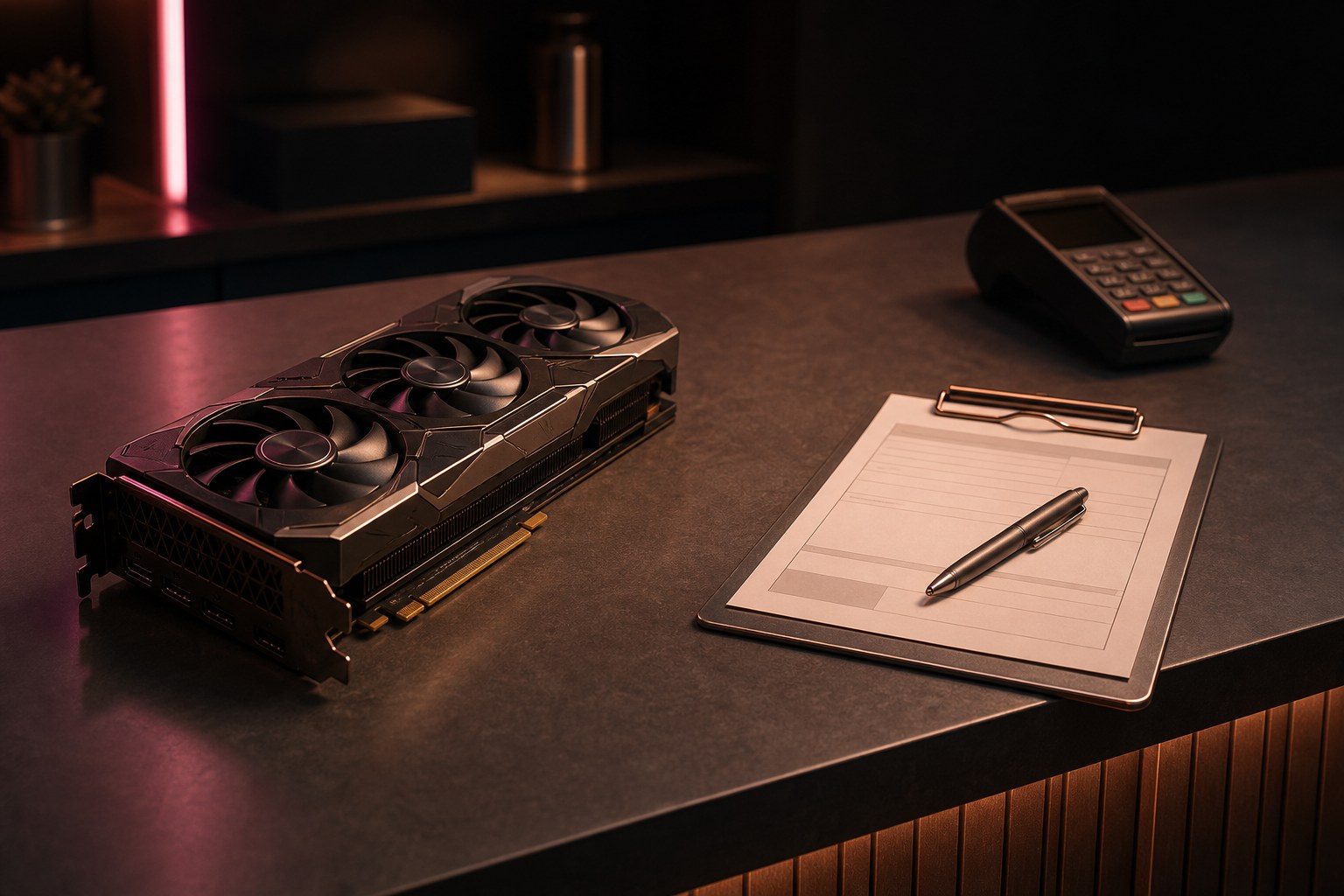
A buyer posted a photograph of a form today, and it reached the radar from four directions within hours. Micro Center has started asking people buying an RTX 5090 to produce a government photo ID and sign something called the Advanced Computing Product Purchaser Declaration.
The form asks for full legal name, a home or business address, photo ID details, a phone number, the intended use, and where the card will be used. The buyer agrees not to export, re-export, resell or transfer the card outside the United States, and certifies it is for personal or business use inside the country. The form says NO EXPORT, NO EXCEPTIONS. Micro Center can refuse or unwind the sale if something in the answers concerns them.
That is a consumer graphics card being sold the way a controlled item is sold.
What the coverage is leaving out
Three things, and they change how worried you should be.
It is not a law. The declaration follows federal anti-diversion guidance, and the guidance is real, but the form itself does not appear to be federally mandated. A retailer went further than it had to. That is a meaningfully different fact from the one most headlines imply.
It is not confirmed everywhere. The reporting describes some buyers and some stores, with store managers citing a policy that took effect in early October. One of the documented cases was a prebuilt system containing a 5090 rather than a loose card.
And all of it traces back to customer accounts. Tom’s Hardware, PC Gamer, TechSpot, Wccftech, VideoCardz and TweakTown have all covered it, which is real corroboration that the form exists and is being used. None of them is quoting a statement from Micro Center or from NVIDIA. If you want certainty about the policy at your local store, the only reliable source is your local store.
One year, three steps
We ran the buy-or-rent arithmetic on this exact card seven days ago, and this is the third thing to move since it launched.
It arrived at $1,999. It is now tracked well above that, reported anywhere from about $4,300 in store to $9,500 from third party sellers, with official retailers largely out of stock. And now, at the biggest specialist retailer in the country, there is a photo ID and a declaration between you and the shelf.
None of that changes the sum we published. The hourly rental price has not moved, the electricity has not moved, and the break-even is still somewhere between seven and a half and twelve thousand hours of actual rendering depending on what you pay. The arithmetic is the same.
What changed is the friction, and friction is a cost the spreadsheet never sees. Renting a 5090 by the hour involves a card number and nothing else.
What to actually weigh
If the card is going into a machine on your desk in the United States, the promise on that form costs you nothing. You were never going to export it. Signing is not a compromise and declining is not a principle.
The new thing is the record. Your legal name, your address and the location where a specific piece of hardware will be installed now sit in a retailer’s compliance file. People can reasonably feel differently about that. Some of our readers run local models specifically because they would rather their work not pass through anyone else’s system, and for them this is a small thing pointing the wrong way. Others will shrug, correctly, because they have handed a shop their ID for less.
What we would not do is treat it as a reason to be clever. The used market and hourly rental both exist, both are ordinary, and neither is a workaround for anything, because for a domestic buyer there is nothing to work around.
What we are watching
Whether this spreads beyond one retailer, whether it reaches cards below the 5090, and whether anyone involved says anything on the record. The first two would tell you something about where consumer hardware is heading. The third would tell you whether this was guidance being followed carefully or a company being cautious on its own.
We will say so here if any of them move.
A daily note from our news radar. The week gets the full treatment in the DIY AI Brief every Monday.