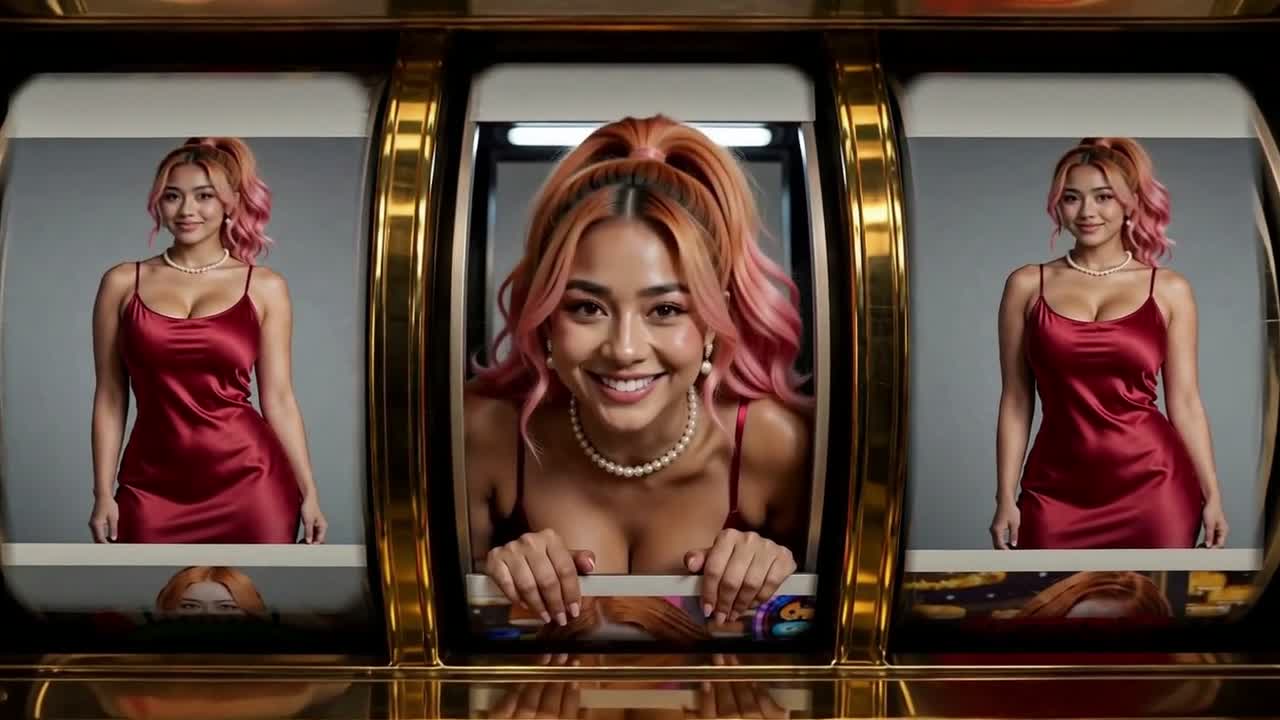
Nobody gets an AI picture right on the first try. You roll, you get a stranger, you roll again, you get her with her eyes half closed, you roll again. The song Roll Again is about exactly that, so we built its music video out of the rolls themselves.
Every picture of me on a slot machine reel, a playing card, a painting or a marquee in this video is a real image generation we logged: 490 rolls on one home PC, the good ones and the ugly ones. Three of those pictures come alive.
The song is ours, made in Suno. Every moving shot of me was generated with MiniMax H3, by MiniMax, used under the MiniMax H3 licence; one of them also uses the H3 Character Swap LoRA v1.5 by Akatz Labs under the same licence. Nothing generated by H3 was used to train anything.
Every number below is ours, measured on one RTX 5090 (32 GB), unless it says “reported”.
The idea: the misses are the set
The brief from the producer was a slot machine of image generations, dancing in a casino, my pictures as the faces of playing cards with the bad one as the Joker, and a couple of moments where the camera finds a picture on a slot, a card or a painting and I start moving from there.
The rule we added: every failure on screen has to be real. If the song says “I kept the photo with my eyes half closed”, the photo on screen is a roll that actually came out with my eyes half closed. No faking a failure, no drawing one on purpose.
What you need
| part | what we used | where it runs |
|---|---|---|
| the pictures | DreamShaper XL, Krea 2 with our character LoRA plus four Krea finetunes, Qwen-Image 2.1, Z-Image, Illustrious and WAI, FLUX.2 Klein 4B | one RTX 5090 |
| the props | Qwen-Image 2.1: the slot machine, cards, the Joker card, marquees, a brass plaque, a painting | same |
| the video model | MiniMax H3 (reference-to-video, int8) with the turbo 8-step LoRA, ComfyUI 0.39.1 | same |
| the slot reels, card showers, karaoke | Python, PIL and ffmpeg | the CPU |
| a second pair of eyes | qwen3-vl 30B in Ollama | same GPU, between renders |
| the song | Suno (our referral link) | the cloud |
The song came from rolling too
The producer made Roll Again in Suno, and it took a lot of rolls, which fits. The vocal he wanted kept arriving with a country twang. Typing out what to avoid made it louder: naming a sound, even to forbid it, puts it in the room. What worked was asking only for sounds that belong to disco and soul (a string section, a full horn section, Rhodes and clavinet), so there was nothing country left to pull on. Suno also ends a song when the typed lyrics run out, so the long count-up at the end (“Roll again! Number two! …”) is typed out word for word.
We measured it before planning a shot: 129.5 bpm, a bar of 1.853 s, cut in two-bar units. Suno gives you stems, and they decided two things:
- Guide audio for H3 is every stem except Backing Vocals. With the choir in the guide, I sang the choir’s echoes too. The producer’s rule: don’t lip-sync the backing vocals.
- Word times come from Whisper. On the full mix, on the lead stem and on the backing stem, because each one hears different things. More on that in the karaoke section.
The image pool: 490 real rolls
Each numbered item in the song is a kind of miss, and each one came from a real machine with real settings. Some came on the first roll. Some we had to hunt.
| # | what it is | machine | hit rate |
|---|---|---|---|
| 01 | a stranger, not me | DreamShaper XL, no LoRA | 2 of 2 |
| 03 | fried colours | Krea 2 + our LoRA at CFG 7 | 2 of 2 |
| 04 | mush | Krea 2 at 3 steps | 2 of 2 |
| 07 | stretched legs | Z-Image at 832x2048 | 6 rolls to catch a good one |
| 08 | eyes half closed | Qwen-Image 2.1 + my two references | 5 in 40 |
| 09 | extra toes | DreamShaper XL, barefoot | 0 countable in 80. It ignored “barefoot” on about 13 of 40 and drew heels, one floating in midair |
| 13 | six fingers | Krea 2 + our LoRA, epoch 19 | 0 in 40. The real flaw it does make: a card floating above an open hand that isn’t holding it |
| Joker | a stranger with two heads | DreamShaper XL at 1536x1536 | our pick of 112 |
| 14 | me | Krea 2 + our LoRA, epoch 20 | the producer’s pick of 8 |
The hunts taught us more than the hits. The marquees in the video print the honest odds from this table: “HALF-BLINK PAYS 5 IN 40”, “JOKER PAYS 1 IN 112”, “SIX FINGERS PAYS 0 IN 40”.
The Joker. The producer’s spec: a stranger with my hair colour but clearly not me, with extra hands and feet. Extra limbs turned up only now and then in 112 rolls (a third leg, a third foot, one pair of extra arms). What DreamShaper XL does reliably at 1536x1536 is split a two-tone hair prompt into two people: “orange roots fading to bright pink ends” became an orange head and a pink head on one body, about 4 to 7 times in every 32. The producer picked seed 1167: “seems like a joker to me”.
Then we added depth: 12 themes (a polaroid at a casino bar, an oil portrait, a neon street in the rain, a 1950s black and white glamour shot, and so on), three machines each out of 11, 144 more rolls. The real failures in there were better than anything we’d have asked for:
- Qwen-Image 2.1 with my two references put two of me in the picture on all 4 polaroid rolls and 2 of 4 at the roulette table.
- Moody Mix (a Krea 2 finetune) gave the 1950s portrait butterfly wings, 4 of 4.
- Klein 4B with no LoRA drew blonde and ginger strangers. Illustrious with our LoRA darkened my skin and lost the pink.
52 rolls we chose not to air, and they stay in the log with the reason. When a theme named the clothes, some engines (three Krea finetunes and Z-Image with its LoRA) ignored the “mid neckline” token and filled in briefs under a jacket, bodysuits or cutouts. Lesson: on those engines, name a covered bottom (“jeans”, “a knee-length skirt”) in the theme.
The slot machine is code, not video
Qwen-Image 2.1 drew the cabinet once: a gold slot machine seen straight on, three reel windows, red buttons, a lit sign on top. Everything that moves on it is Python:
- three drums drawn over the reel windows, with a cylinder warp, shading and a 6-sample motion blur
- a stop with a small bounce, and the reels stopping left to right
- every tile a real gen from the pool log, cropped head to waist so the face reads
- the two tiles before every stop are always themed gens, because those are the only ones your eye can read as a drum slows
Each spin starts on a “Roll again” and lands on the word: “Number two” lands on #02, “Number nine” on #09, the Joker flashes past on the second “ten”, and the near-misses for #14 come before the jackpot at 3:04. A spin renders in about 12 seconds on the CPU.
We tried letting H3 spin the reels first. The blur looked right, but H3 decides where the reels land. One seed landed back on the same three pictures. The other landed on a blue-eyed blonde in a blue dress that we never generated. The producer kept that one. Blue-eyed blondes used to turn up all the time when he was trying to generate me, because there are so many of them in the training data: “Epitome of a missed roll.” It’s at 0:43. Everything else on the reels is code, so every landing is a real roll.
Build the props flat, then put them in the scene
Asking for “her on a playing card” in one step gave us a 4 of spades. Building the card flat first worked:
- Qwen-Image 2.1 edit, the gen as
<image1>: “A single flat playing card seen straight on … the Ten of spades … the center of the card is a printed illustration … exactly the picture<image1>, unchanged.” - Then a second edit puts the flat card into the scene: on the felt, in a stock hand.
The Joker card reads JOKER in both corners, the right way up. The marquees and the House Rules plaque came out with exact text on the first seed, except one marquee that read “1 1N 112” (the second seed was clean).
One real miss we kept: on the Queen and the King, Qwen ignored the picture and drew traditional court figures. Those two went out of the card fan after the producer’s first look.
Making a picture come alive
Everything in the video leads to this move, and it has one rule: the picture has to be the opening frame.
| test | result |
|---|---|
| a slot screen with my picture given only as a reference | failed. H3 handed back the stock clip; the picture never reached the screen |
| the same screen with the picture edited onto it, pinned as frame 0 | the picture held for all 5 s |
| a card on the felt as frame 0, my two references beside it, the line as guide audio | I rise out of the card and say the line, 2 of 2 seeds |
| a Qwen oil portrait in a gold frame as frame 0 | I blink, smile and lean out over the frame, 2 of 2 |
| the coded spin’s jackpot frame as frame 0 | I grip the middle reel window and lean out laughing, 2 of 2 |
The pinned frame (--guide-image file@0) locks where everything is. The same picture also goes in as <Picture 3> so H3 knows what it is looking at. A set picture given only as a reference steers the style and nothing else: every seed invented a different casino.
The prompt for the jackpot, trimmed:
<Picture 3>is the opening frame: a gold casino slot machine seen front-on, its three reels showing printed pictures of the young woman from<Picture 1>, a jackpot. The camera pushes in on the middle reel and the picture on it comes alive: the young woman from<Picture 1>, her face as in<Picture 2>, … turns her head, smiles, and leans out through the reel window toward the camera … and says the spoken line in the soundtrack with a delighted smile.
The producer’s call on the ending changed the plan: “For S44 she should come to life from the reel not the card.” So “Number fourteen. There she is.” comes out of the jackpot reel, straight off the last coded spin, and because the first frame is the spin’s last frame, the cut doesn’t jump.
What H3 still can’t hold
The producer reviewed the animatic and found the edges. Some we fixed, some we worked around.
| what went wrong | why | what we did |
|---|---|---|
| playing cards in my hands changed faces, popped in and out, grew blob pips | H3 can’t keep a small printed card consistent while it moves | swapped the props: chips instead of cards, plain red card backs only, empty hands. The producer: “the chip stacks and spin are great alternatives” |
| garbled letters printed on the table felt | H3 writes made-up text on felt | “plain blue felt with no printing or text” helped but didn’t cure it; it stays small and low in frame |
| my hand and the lever came out as nubs | a hand on a prop described in words | a Qwen frame 0 of my hand wrapped around the lever ball: five fingers on all 9 takes. The producer still liked the first lever take better in two spots, where the big red ball pulled the eye |
| my eyes drooped shut unevenly, one before the other | H3 doesn’t do quick blinks on request | re-rolled 4 seeds. All four close both eyes together on the held note, which reads as singing with my eyes closed |
| extra mouthing at the card table | the prompt said “shakes her head on each ’nobody’”, a lyric word given as an acting cue | took every lyric word out of the action. Mouth movement dropped 20 to 40% across 3 seeds |
| H3 dropped me into a grey studio at 4.9 s | a re-roll wandered off | the other seed |
That last mouthing test had a second arm: the same new prompt with only the lead vocal as guide audio. It moved slightly more, not less, on every seed. The prompt was the fix, not the audio.
A second pair of eyes
The producer gave the GPU over for the run: “if a take needs a second set of eyes have the local agent look at it between renders”. So after each shot, the H3 server was freed and qwen3-vl 30B looked at six frames of every take against a checklist: one performer, no extra people, hands, outfit, action, artifacts.
It raised 20 flags on 60 takes. One was real (giant garbled text on a table). Most were not: motion-blurred hands read as extra fingers, and “her lips don’t match” from a model that can’t hear the audio. It also missed gold arches that bent and melted halfway through a take. It’s a triage list, not a gate. A person looks at every take.
For blinks and mouths we wrote a better instrument: a strip that finds my face in every frame at 8 fps and crops just the eyes or just the mouth, each tile labelled with the word being sung. Six frames can’t show a blink. Forty can.
Karaoke from the stems
The lyric sheet and the song don’t match. The words as sung come from three Whisper passes:
- the bridge is “So, no editing, just roll again!”, not the sheet’s “stop fixing it”
- in the count-up the choir sings “Roll again” and the lead answers with the numbers
- “number ten” is sung twice, then twelve
- a “Yeah, yeah, yeah, yeah” at 3:18 that only the lead stem hears
The timing comes from the full-mix pass, the only one that heard all three “roll again"s in each chorus line. A difflib alignment matched all 53 lines. The captions are an ASS subtitle file with a \kf sweep, each word filling white to gold as it’s sung, burned in during the final encode at 1080p, so the picture isn’t compressed one extra time. The same words go up as a normal caption track on YouTube.
We didn’t colour the lead and the choir differently. The stem passes disagree on which voice has each echo, and a wrong colour is worse than one colour.
The run
| stage | what | time on the 5090 |
|---|---|---|
| image pool | 490 rolls, 0 errors | about 1 h 05 min |
| props | 34 Qwen images (marquees, plaque, cards, chips, felt, wall), plus the cabinet, the painting and the frame 0s in the proof rounds | about 6 min for the 34 |
| proofs | 34 H3 takes, three rounds | about 2 h |
| production | 60 takes, 25 shots | about 2 h 20 min |
| re-rolls after the producer’s notes | 39 takes | about 1 h 30 min |
| spins, inserts, karaoke, the cut | code | CPU, minutes |
About 7 hours of GPU for 3 minutes 27 seconds. Every one of the 133 H3 takes rendered; every rejection was a take that rendered fine and was wrong. The final cut has 34 H3 shots, 9 coded spins, 10 coded inserts and one still.
Run one yourself
- Download the kit. It has the ComfyUI graphs we sent (the reel and the painting coming alive, a hand on a prop, singing at a table, a swap, the Qwen card, marquee and lever frame), every prompt, the pool log with all 490 rolls and their settings, and our scripts: the slot machine spin, the inserts, the karaoke maker, the eye and mouth strips. No song, no pool images, no model weights.
- Roll a pool with real settings, and log every roll: model, settings, seed, file. The log is what lets you print honest odds.
- Build each prop flat with an image editor first, then put it in the scene.
- To bring a picture to life, make it frame 0 and a reference.
- Keep small printed things out of moving hands.
- Give H3 every stem except the backing vocals.
- Look at every take. Label the result as AI.
Credits
- MiniMax H3, by MiniMax, under the MiniMax H3 licence.
- H3 Character Swap LoRA v1.5, by Akatz Labs, under the same licence (the casino table swap at 1:34).
- Roll Again: written and made by the producer in Suno (our referral link).
- Stock footage from Pexels by Pavel Danilyuk: a woman at the table and a hand holding cards. Thank you.
- Image models in the pool: DreamShaper XL, Krea 2 and the CyberRealistic, DarkRealism, Moody Mix and LiquidMix finetunes, Qwen-Image 2.1, Z-Image, Illustrious and WAI, FLUX.2 Klein 4B.
The next music video is a rap, and a proof of concept for H3 lip-sync on fast lines, with every shot that still looks wrong flagged on screen: How to Make an AI Rap Music Video With Lip-Sync on One RTX 5090.
Older guides
The lessons from all six music videos are in one place, in order from the song to the upload: How to Make an AI Music Video at Home on One GPU: The Ten Steps.
Putting me into other people’s footage is How to Put an AI Character Into Real Stock Footage, our first music video on one GPU is Make a Full AI Music Video on One GPU, and the one drawn entirely in code is How to Make a Music Video with Claude Code. H3 itself, measured on one card, is in MiniMax H3 on One Gaming Card.
Which roll should come alive next? Tell me in the comments on the video, or in r/aillex.