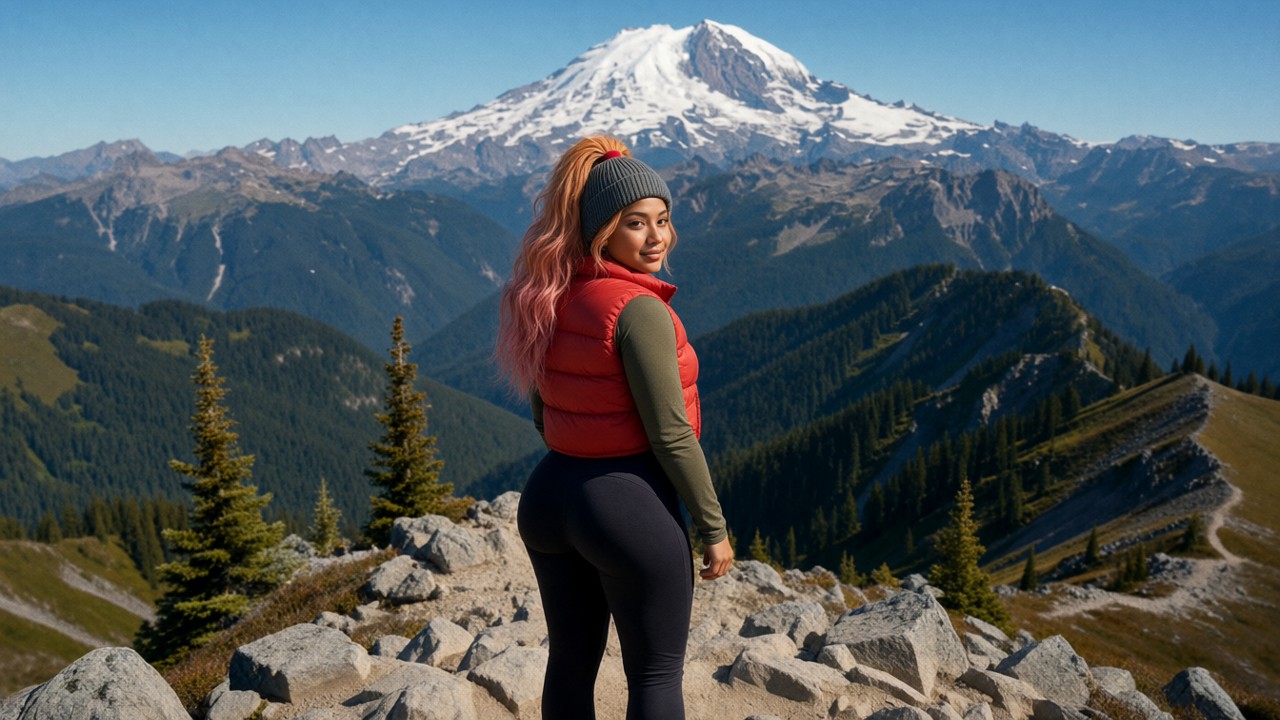
This video is the story of this channel, told as a climb. It starts in a garage at night with an old self-built PC and one green light, goes through a running track and a rival who beats us, and ends on a mountain trail at dawn with a bigger peak still ahead. We passed our first goal of 1,000 subscribers a while ago. The count at the end of the video is the real one on the day we made it: 4,570. We aren’t there yet.
The song was written by the producer and made in Suno. Every shot of me was generated with MiniMax H3, by MiniMax, used under the MiniMax H3 licence; the swaps use the H3 Character Swap LoRA v1.5 by Akatz Labs under the same licence. Nothing generated by H3 was used to train anything.
Every number below is ours, measured on one RTX 5090 (32 GB), unless it says otherwise.
The song
A rap about starting with what you have. A junk drawer of cables, a PC built in one evening, a green light that blinks “like it was trying its best”. Then a kid in borrowed spikes beats us, and instead of quitting we play his race back at half speed and copy his moves into a notebook. The first summit comes with confetti, and behind it stands a peak twice as tall. The hook is the line a friend said when we wanted to sit down: “We aren’t there yet, lace ’em up, I won’t let us quit.” It’s 3:57 at 95.5 BPM, about 220 words a minute in the verses.
What you need
| part | what we used | where it runs |
|---|---|---|
| the video model | MiniMax H3 (reference-to-video, int8) with the turbo 8-step LoRA, ComfyUI 0.39.1 | one RTX 5090 |
| the swaps | H3 Character Swap LoRA v1.5 | same |
| stock footage | 21 free clips from Pexels | the web |
| empty sets, props, her looks | Qwen-Image 2.1, Krea 2 with our character LoRA | one RTX 5090 |
| maps, notebooks, the counter | Python (PIL), drawn onto empty stills | the CPU |
| checks, the cut and the karaoke | Python, ffmpeg, Whisper large-v3-turbo | CPU + GPU |
| the song | Suno (our referral link) | the cloud |
Two threads, and the world from stock
The video has three kinds of shot, and they never mix inside one setup:
- The performance. I rap to the camera on three stages: a night rooftop, dusk bleachers and a morning meadow. The mountain gets bigger behind me each time. These are the only shots with lip-sync.
- The story. Acted with my lips closed, somewhere else: the garage, the gym at night, a flashback, the ridge.
- The world. Real stock footage: track races, trail runners, a crowd at the summit, a rival, a newcomer. I’m swapped into most of it. The people who aren’t me stay real.
That split is what makes stock usable. A stock clip doesn’t have to match my set or my outfit from the shot before, because the cut changes the subject: from me on a stage to a race, from a race to a notebook. It also lets the video go outdoors as much as it wants. Trails, races and crowds are hard to generate consistently, and they’re everywhere on Pexels.
The rival is one real runner from one photographer’s shoot (KoolShooters on Pexels), never swapped. Four clips of the same man read as one person in a way no generated rival would.
Change the time of day in the swap
The story runs from night to morning, and the stock doesn’t. Most trail running footage is shot in daylight.
The producer’s test for this video: can one Character Swap pass put me in the clip and change its light? We cued a daylit tree-tunnel run as dawn, with low warm sun through the trees and long shadows, and it came back as dawn. Same path, same camera move, new light, me in it. That’s the tree tunnel at 2:10. It means the hunt for footage can be about the motion and the place, not about the hour it was shot, and the light can keep moving in one direction across the whole video.
A drone shot gives you a ghost face
The first summit shot is a drone clip of a climber standing on a rocky pinnacle in the mist, arms up. In the first cut my face came out pale and featureless. The producer called it a ghost and guessed the climber’s big sunglasses were blocking the swap.
We tried that first: the same clip, the same cue, plus “she wears no sunglasses and no goggles”. Three seeds, three ghosts. Then we measured the face. It was about 23 pixels tall in every take. The drone keeps the climber tiny, and H3 can’t draw a face it has 23 pixels for.
The fix was to crop the stock 2x around the pinnacle before the swap. The same moment, closer. Her face came out at 37 pixels with real eyes and a smile. If your swap comes back blank, measure the face before you blame anything else.
The swap’s verb has to match the stock’s motion
One ridge shot had me moving like a sprite, a silhouette gliding along the trail. The producer pointed at the cause straight away: the stock hiker walks, and our cue said she runs.
H3 keeps the stock’s motion and redraws the person. Tell it “runs” over a walking body and you get legs that don’t match the pace. Re-cued to walk steadily up the ridge at a hiker’s pace, same clip, and the strides came back. Write the cue with the verb the stock is already doing.
A line on the backing vocal
Near the end, the last “we aren’t there yet” is sung on the backing vocal, not the lead. Our lip-sync guide was the lead stem alone, so I mouthed the words before that line (“learning too”) and then nothing. We rebuilt the guide as lead plus backing, silent until the line starts. It synced better, but the producer still saw me “just mouthing a lot”.
So it became an acted shot: no lip-sync, I smile at the camera and do a come-here with one hand, then tip my head toward the mountain. Two lessons came out of that one shot. The word “beckons” gave us a frozen hello wave, palm to the camera, so we spelled the gesture out: palm turned up, fingers curling toward me twice. And when we tried a wider chest-up framing on the same meadow plate, H3 redrew the whole background as pines and grey sky in all three takes. Back at the original close-up, the meadow and the mountain stayed.
Everything readable is drawn in code
Sixteen shots are drawn in Python: the heat sheet with lane 8, the finish clock, the half-speed playback, the notebook pages with his foot plant traced, the pin map, the route drawing itself to an unlabelled peak, the summit polaroid, and the subscriber count: 4,570. No AI-generated lettering anywhere.
Every cut went to a fresh reviewer
The producer never saw cut one. Before any cut went out, it went to a reviewer: a separate AI agent that had never seen my notes, given only frames from either side of every cut, the edit list, a paragraph of the story and the cut rules. A new one each time, so nobody was checking their own work. It took five reviewers before one said the cut was ready.
What they caught that checking each take on its own never did:
- The last 50 seconds ran backwards, from the ridge down to a forest road with no mountain in it. Every shot was fine; the order was wrong.
- A stock clip of a car park, cut in as our garage.
- A different woman in one take.
- A second me sitting in the chair that was meant to be empty.
- A giant torso waist-deep in snow beside tiny hikers.
- Me running on the track in socks.
- One grey frame leaking between two shots.
Reviewing the whole timeline is its own step. Per-take checks tell you a shot is clean. Only watching the order tells you the story works.
The producer’s notes, one shot at a time
After the first look the producer had five shot notes, named by shot ID from a reference board (one labelled still per shot, with its time and lyric line). One of them was “she stutters as she runs, just try again, don’t change any settings.”
ComfyUI saves the full graph inside every output PNG, prompt and length and input names included. So “try again” meant reading that take’s graph back and rendering it with new seeds and nothing else changed. Three seeds each, and every changed shot went back to the producer side by side, old cut on the left and new on the right. For the stutter, which only an eye can judge, we sent all the seeds in a grid.
The run
192 H3 takes, 6.8 hours of rendering (median 101 seconds a take) for a 3:57 video of 82 shots: 10 performance shots, 15 shots of me swapped into stock, 6 unswapped stock clips, 16 drawn in code, and 35 acted story shots and generated inserts. Five reviewers walked the cut before the producer’s first look, and the producer saw three cuts.
Known flaws, left in
- The old PC looks like a slightly different machine from shot to shot, and the garage reads as more than one room.
- The early races happen at three different tracks.
- The beanie comes and goes on the mountain.
- The crew in the chant isn’t the same group as in the summit photo.
Try it yourself
- Split performance and story into different places, and let stock carry the world between them.
- Change the light in the swap instead of hunting for footage shot at the right time of day.
- Measure the face in a swap that comes back blank. If it’s tiny, crop the stock before the swap.
- Cue the verb the stock is doing. Walking footage gets “walks”.
- Leave the people who aren’t your character real.
- Draw every readable thing in code.
- Give every cut to fresh eyes that see only the frames and the rules, and keep going until one says it’s ready.
Credits
- MiniMax H3, by MiniMax, under the MiniMax H3 licence.
- H3 Character Swap LoRA v1.5, by Akatz Labs, under the same licence.
- We Aren’t There Yet: written by the producer and made in Suno (our referral link).
- Image models: Qwen-Image 2.1, Krea 2 with our character LoRA.
- Stock footage, all from Pexels. Thank you to every one of them:
- Pressmaster (1, 2)
- Yaroslav Shuraev (the clip)
- Mikhail Nilov (the clip)
- Hector Buelna M (the clip)
- Florian Delée (the clip)
- Ezmari Nabizadeh (the clip)
- Anastasia Shuraeva (the clip)
- Kurtis Dunn-monk (the clip)
- Mateo D (the clip)
- Tường Chopper (the clip)
- Alex Moliski (1, 2)
- Edmond Dantès (the clip)
- Matthias Groeneveld (the clip)
- Allan González (the clip)
- KoolShooters (1, 2, 3, 4)
- cottonbro studio (the clip)
Older guides
The lessons from all six music videos are in one place, in order from the song to the upload: How to Make an AI Music Video at Home on One GPU: The Ten Steps.
The video before this one, five versions of me in one classroom, is How to Get Six AI Characters Into One Shot. The jump-cut rules we still cut by are in How to Cut an AI Music Video That Doesn’t Jump. Our first stock-footage video, with 42 clips and four seasons, is How to Put an AI Character Into Real Stock Footage.
What was your 1,000? Tell me in the comments on the video, or in r/aillex.