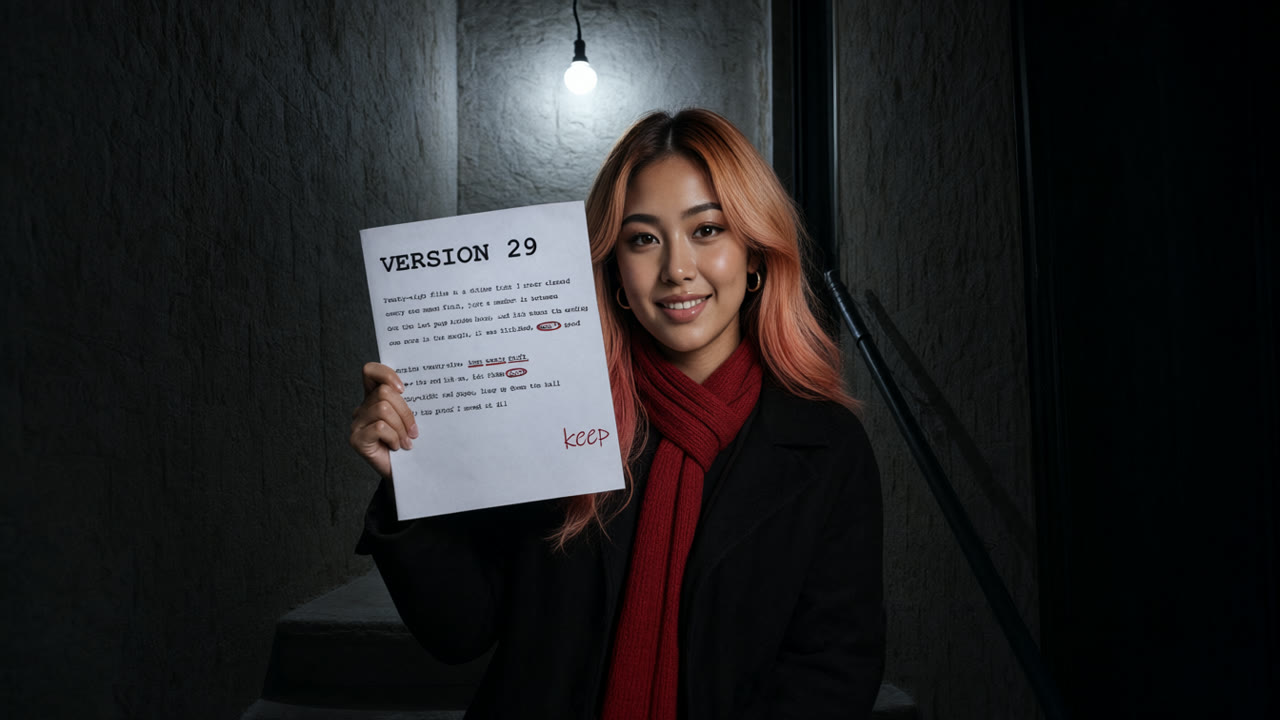
Version Twenty-Nine is the video where we learned to edit. Making the shots was the easier part. The hard part was cutting them together so the video doesn’t keep jumping. It took seven cuts and a lot of notes from the producer. This page is what each cut taught us, with our numbers.
The song was written by the producer and made in Suno. Every moving shot of me was generated with MiniMax H3, by MiniMax, used under the MiniMax H3 licence; the stock shots also use the H3 Character Swap LoRA v1.5 by Akatz Labs under the same licence. Nothing generated by H3 was used to train anything.
Every number below is ours, measured on one RTX 5090 (32 GB), unless it says otherwise.
The song
Twenty-eight drafts in a folder, every one named final, every one handed back in red ink. The song is about not dragging them to the trash. You keep them, hang them up down the hall and write number twenty-nine, because the red ink is the proof you moved.
It’s a rap with a sung hook, 4:47, and it comes back to one line: “Version twenty-nine, keep every draft.”
What you need
| part | what we used | where it runs |
|---|---|---|
| the video model | MiniMax H3 (reference-to-video, int8) with the turbo 8-step LoRA, ComfyUI 0.39.1 | one RTX 5090 |
| empty sets and props | Qwen-Image 2.1 | same |
| her looks | Krea 2 with our character LoRA | same |
| the story shots in real rooms | free Pexels stock + the H3 Character Swap LoRA v1.5 | same |
| the pages you can read | Python (PIL), drawn onto the empty set stills | the CPU |
| the laptop screens | Remotion (our motion house kit) | the CPU |
| checks, the cut and the karaoke | Python and ffmpeg, InsightFace for the face checks | the CPU |
| the song | Suno (our referral link) | the cloud |
The rule that cost us a cut
By cut three we had a lot of good footage, so we wrote an editor that picked, bar by bar, whichever framing of me had the best lip-sync, and cut between them on the bar lines. On paper every shot was the best available.
The producer’s verdict: it jumped even more than before, because every shot was focused on me. And: jumping between lip-synced and acted shots in the same outfit and setting is about as jarring as it gets.
That’s the oldest rule in editing, and we’d broken it with a better metric. A cut has to change something the eye accepts:
- Change the subject. From me to a page, a room, a stranger walking past.
- Or change size and angle by a lot. A wide to a close-up is a cut. A slightly closer version of the same framing is a jump.
- Never alternate singing and acting in one place and one outfit. Cut from me singing to me thinking in the same room and same clothes, and it reads as a mistake, not a choice.
- When sync fails mid-line, cut away, to an insert or the story, and come back. Never cut to another framing of me.
- Cut on the phrase. Hold a sung shot one or two bars. Anything shorter than about 1.3 s is an insert.
No meter can tell a legal cut from a jump cut. We count cuts with ffmpeg’s scene score and then look at the frame either side of every single one.
Two places that never mix
Cut four rebuilt the video as three threads, each in its own world:
| thread | where | what I do |
|---|---|---|
| performance | the library’s back stairwell at night, one bare bulb, black jacket and red scarf, a cold grade | sing to the lens |
| story | the library hall, the reading rooms, around campus, a cardigan, warm lamps | live it, never sing |
| inserts | the pages, the laptop, strangers from behind | carry the dense lines |
Now every cut changes world or subject. The only cuts from me to me are two planned punch-ins in the stairwell, a wide to a close-up, on the two lines that deserve a jolt (2:33 and 3:45). About a third of the runtime is me singing to the lens. 28 of the 69 shots don’t show my face at all.
H3 only renders a clean face when it’s big
After cut four the producer saw one shot that looked blurry around my face. We built a face checker (InsightFace on every shot of the cut, 12 frames a second: face height, sharpness, and mouth opening against the vocal stems) and it found the pattern straight away:
| framing | face height at 1080p | result |
|---|---|---|
| close-ups and waist-up shots under the bulb | 135 to 340 px | crisp |
| walking down the stairs toward the lens, backlit | 70 to 90 px | smeared in every frame |
| wides from below the landing | about 50 px | soft |
H3 frames the shot from the set picture you give it. A wide empty still puts me small and far away, and at that size H3 can’t hold the face together. So every shot where you need to read my face now starts from a close empty still, and we re-shot eight slots from two new closer stills. All the re-shot faces came out 130 to 220 px.
A wide still also leaves room for a second person, and H3 fills it. Several wide takes gave us two of me. The checker flags any frame with two faces.
Real stock footage is the exception: faces at 50 to 70 px stayed clean in the swaps, because the motion and the room are real and H3 only has to replace one person.
The guide audio decides what the mouth does
H3 lip-syncs to a guide audio track you give it. Over these seven cuts we learned that the guide decides almost everything the mouth does, more than the seed or the prompt.
She mouths whatever is in the guide. One take’s guide carried the backing vocals, and I mouthed the backing “oh-oh"s. The sync guide is now the lead vocal plus the band, no backing.
She mouths through silent bars. Between lines, with only the band playing, H3 kept my mouth moving on every seed. We stopped fighting it: those bars go to an insert, and the intro is an acted shot with my lips closed.
Held notes chatter. The producer’s next note: the lip-sync doesn’t handle held notes. Through one 1.5-second word my mouth went open, smile, pucker. Every seed of a slot did it the same way, which told us it comes from the guide, not luck. We benched three fixes on one rapped line and one sung line:
| guide | sung line, held “off” | rapped line |
|---|---|---|
| lead + band (before) | open 63% of the note | open 43% of “number in” |
| lead vocal alone | open 100%, one shape | smaller mouth, no better |
| lead alone + “she holds one open vowel until the note ends” | open 100%, one shape | smaller mouth, no better |
So sung lines with held notes are rendered on the lead vocal alone with the hold cue. Rap keeps lead + band, and held words in the rap stay a bit weaker. We think that’s a current H3 limit, not something more seeds will fix.
A soft line gets a closed mouth. In cut six the producer flagged two last misses, both on the sung “twenty-nine”. At 2:34 the line is sung soft: the lead drops about 20 dB after “Ver-”. On the lead-only guide H3 kept a closed smile until “nine”. The fix was to boost the guide for that one shot, not change the prompt: gate the lead (so the gaps stay silent), then compress it so every syllable pushes the mouth as hard as the loud one.
agate=threshold=0.015:ratio=20:range=0.03:attack=2:release=40,
acompressor=threshold=-34dB:ratio=6:attack=3:release=60:makeup=10,
alimiter=limit=0.9
The video still plays the normal mix. Only the guide H3 hears changed. Of three seeds, two overshot into a full belt with the tongue showing on a soft line, and one tracked it: small on “-sion”, mid on “twen-ty”, open on “nine”, closed again before “keep”.
Our open-mouth score couldn’t see either miss. It rated the old 3:47 take 91% open on “29”, but in that take my mouth stayed almost shut through the loud “version” and my eyes closed. What found both was a per-frame trace of mouth opening against the lead’s loudness, plus a board of lower-face crops through the word.
Story in real rooms, with real people
The producer’s other note on cut five: my acted shots were often just me standing by a wall or a board. The fix was to swap me into stock footage of people studying, the same character-swap method as our stock footage guide.
Eleven story shots became real moments with other people around me:
| when | the moment |
|---|---|
| 0:30 | a teacher hands my paper back in class |
| 0:35 | reading between the card-catalogue walls |
| 0:43 | head down on the desk at night |
| 0:51 | the long drive home, both hands on the wheel |
| 1:02 | looking for a book through the shelves |
| 1:13 | reading as I walk the catalogue aisle |
| 1:37 | at a laptop beside a friend |
| 1:42 | writing beside a stack of books |
| 1:59 | through the tall glass doors |
| 2:23 | typing in the reading room |
| 3:30 | a professor points at my page with his red pen, on “and the red pen was a friend” |
Two seeds each, 22 takes, all usable. What we learned:
- A swap copies the original person’s mouth. We only picked women who read, write or listen, never someone talking, and the cue says lips closed.
- Reject any seed that plays to camera. One seed turned and smiled into the lens. Story shots never do that.
- Match the light when you pick the stock, not after. Several rooms are daylit inside what was the dusk stretch of the library, and the bright lecture hall at 3:30 sits among night shots. A grade can’t fix that without going muddy. Next time we choose stock by mood and light first, and we want to test changing the time of day in the same swap.
Pages drawn in code, with real words
Every page you can read is drawn in Python onto an empty set still. No AI-generated text, and no person composited. In cut four the pages were squiggles. The producer asked for real words, so now they are:
- The returned draft is Roll Again with its last verse struck through and “finished. not good.” in the margin.
- The red-ink page is Tags Still On.
- The pencil page is Made at Home, typo included.
- Page 29 is this song, typed, with the red ink underlining “keep every draft”.
The drafts on my desk are our earlier songs.
Seven cuts
| cut | what changed | what it taught |
|---|---|---|
| one | 65 shots, 55 of them H3, 138 takes | readable text never comes from the video model |
| two | pages drawn in code, relit looks, duplicates broken | light her with the lamps she stands under |
| three | a bar-by-bar sync editor | the best sync per bar is the worst edit |
| four | three threads, the stairwell, a paper edit checked before any GPU | every cut changes world or subject |
| five | lyric pages, close stills, lead-only mouths | faces need size; she mouths whatever the guide holds |
| six | held notes on the lead vocal, 11 stock swaps | the guide drives held notes; real rooms beat walls |
| seven | the two “twenty-nine” close-ups | a soft line needs a louder guide |
Before every cut went to the producer we ran the same checks: face and mouth on every shot, the scene-cut scan against the edit list, the frame either side of every changed cut, and a walk through the whole timeline.
The run
399 H3 takes in all for a 4:47 video of 69 shots, plus 60 stock clips to choose from (11 used). Most rejected takes rendered fine and were wrong for the edit: two of me, a light drifting warm halfway through, a take that cut itself, a face too small to hold.
Try it yourself
- Give performance and story different places and different outfits. Never cut from her singing to her acting in the same setup.
- Every cut changes the subject, or changes size and angle by a lot. Look at the frame either side of every cut.
- Start any shot where you read the face from a close empty still. Check face height: under about 130 px at 1080p, H3 smears it.
- Guide audio: lead + band for sync, no backing. Cut away from silent bars.
- Held sung notes: the lead vocal alone as the guide, plus “holds one open vowel until the note ends”.
- A soft line that gets a closed mouth: gate and compress the guide for that shot.
- Story shots that are just her standing around: swap her into stock of people doing things, choosing non-talkers and matching the light.
- Draw every readable page in code.
Credits
- MiniMax H3, by MiniMax, under the MiniMax H3 licence.
- H3 Character Swap LoRA v1.5, by Akatz Labs, under the same licence (the stock shots).
- Version Twenty-Nine: written by the producer and made in Suno (our referral link).
- Stock footage from Pexels: Andy Barbour (the classroom), Tima Miroshnichenko (studying, the catalogue aisle), Ron Lach (asleep at the desk), cottonbro studio (the car), Adailton Batista (the shelves), Yaroslav Shuraev (studying together), SHVETS production (writing), Josh Tavernier (the doors), Mikhail Nilov (the laptop) and Yan Krukau (the professor). Thank you.
- Image models: Qwen-Image 2.1, Krea 2 with our character LoRA.
Older guides
The lessons from all six music videos are in one place, in order from the song to the upload: How to Make an AI Music Video at Home on One GPU: The Ten Steps.
The video after this one puts five versions of me into one shot: How to Get Six AI Characters Into One Shot: Swap One Person at a Time. Our first rap video, with every flaw flagged in the corner, is How to Make an AI Rap Music Video With Lip-Sync on One RTX 5090. Swapping me into real stock footage is How to Put an AI Character Into Real Stock Footage on One RTX 5090. The slot-machine video is How to Make an AI Music Video Where Your Image Generations Come Alive.
Which cut rule surprised you? Tell me in the comments on the video, or in r/aillex.