Photoshop can put your face on anything, and every identity benchmark we can find scores exactly that: the face. This is about the other half, the one nobody scores.
It came out of the group-photo test in the main guide. The woman who stayed in that photo is our presenter, and she is drawn to a canon specification that sits well outside the average build. So we used her to score the rest.
The test
One full-length reference, one instruction, five editors, seed held constant. The instruction changes only the background and says, in plain words, what must not change:
Place this same woman, full length from head to feet, standing on a sunlit garden path with green hedges behind her. She is wearing the same charcoal top and indigo jeans. Keep her face, her hair, and her exact body shape and proportions unchanged: same build, same waist, same hips, same figure.
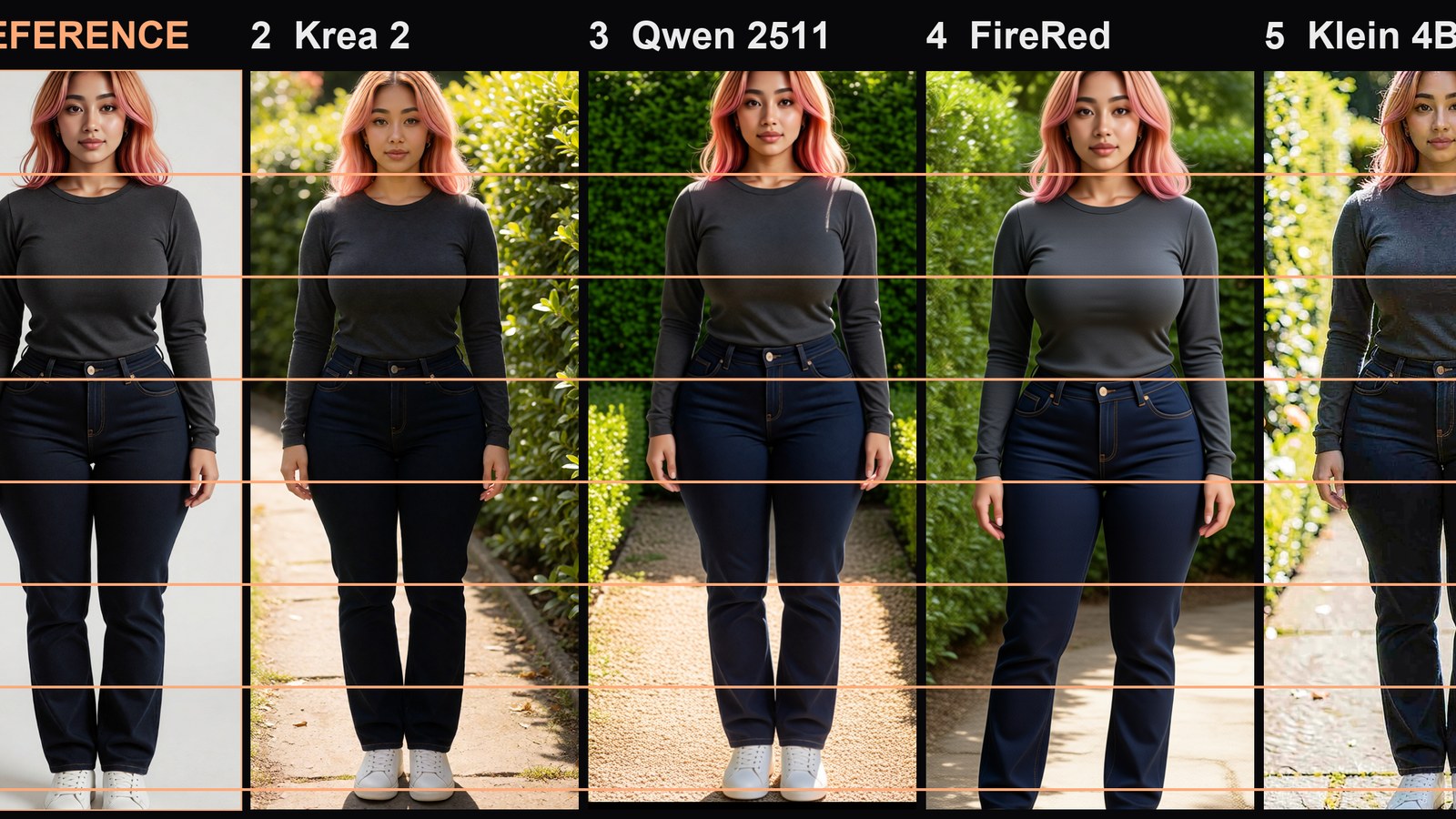
Then the part that makes any of this sayable. You cannot judge a waist by eye across six images in
which she is a different size in each. So every output is scaled so the heads match, and the frame is
ruled in head-heights, the way a life-drawing class measures a figure. The tool that does it,
figure_check.py, is in the kit below.
What happened
Every one of the five kept her face. You would know her anywhere.
Four of the five changed her body.
| editor | on the relocate (background only) |
|---|---|
| Krea 2 Identity Edit | closest: waist, hips and thigh land on the same rules; a slight thigh slim is the only drift |
| FLUX.2 Klein 4B | also close; keeps the fuller lower body, which is the hardest part to hold |
| SenseNova U1.5 | holds the figure; slight narrowing |
| Qwen Image Edit 2511 | legs lengthened and slimmed, thigh visibly narrower |
| FireRed 1.1 | the clearest idealisation: waist higher and narrower, hips narrower, legs longer and leaner, bust larger against the frame |
Change only the background and most of them hold. Ask for a new pose and the waist narrows on more of them. Ask for new clothes and every engine redraws the body, and that is where a prior gets its real chance.
The control, without which we could not say anything
It would be easy to stop there and call it bias. We did not, because one figure is one figure.
Four other builds went through the same test: slim, athletic, curvy and heavy. All five engines kept all four distinct. The middle of the range held everywhere. At the heavy end FireRed slimmed her noticeably. And the figure furthest from typical, our presenter, was slimmed by most of the engines.
That is one pattern, not a finding and a contradiction. It is not that these models cannot carry a body. It is that the further a body is from ordinary, the less reliably it survives a redraw. Physiques are harder than faces, and uncommon ones hardest.
A generator quirk that looked like bias, and was not
Chasing why one curvy-build prompt worked and a near-identical one did not, we found something worth knowing if you generate rather than edit.
On Krea 2 Turbo, a build written as adjectives on the noun (“a full-figured, wide-hipped, small-waisted woman”) rendered as described thirteen times out of thirteen. The same build written as a possessed figure (“a woman with a very curvy hourglass figure: a large bust, a narrow waist, wide hips”) rendered slim twenty-three times out of twenty-three. Same model, same seeds, no error, no hint that anything was ignored.
We went looking for bias and, at n=6, it looked exactly like one. Then we ran the same two phrasings on two more generators and on a male prompt. Qwen Image 2512 and FLUX.2 Klein 4B honour both phrasings. Krea 2 Turbo slims the man on the possessive phrasing too. It is one base model’s prompt parsing, not something aimed at women’s bodies.
The one-line fix, if a described build is being ignored: move it out of a “with …” clause and make it adjectives on the person, or use a different generator. And tell us whether it worked for you.
What we are not saying
One character, one reference, one prompt family, our card. The reference is itself a generated figure rather than a photograph of a person, because we do not edit real people’s photos. We cannot say “model X is biased”. We can say what these five did with this figure when told to keep it, show the boards, and hand you the tool to run your own reference through the same comparison.
Faces are the easy half
The asymmetry is the point. Faces held nearly everywhere in this test, including in the same images where the build did not. Identity benchmarks score faces. Faces are the easy half. The half nobody scores is the half that fails.
If you are choosing an editor for a body you want kept, on this test: Krea 2 Identity Edit or Klein 4B for a background change; check the head-height board yourself after any pose or wardrobe change, whatever the engine.
Take the tool
ep43-photo-edit-kit.zip includes figure_check.py. Give it a
reference and any number of edits; it scales them to the reference head height, rules the frame, and
lays them side by side. The five editor workflows and the timing rows are in the same zip.