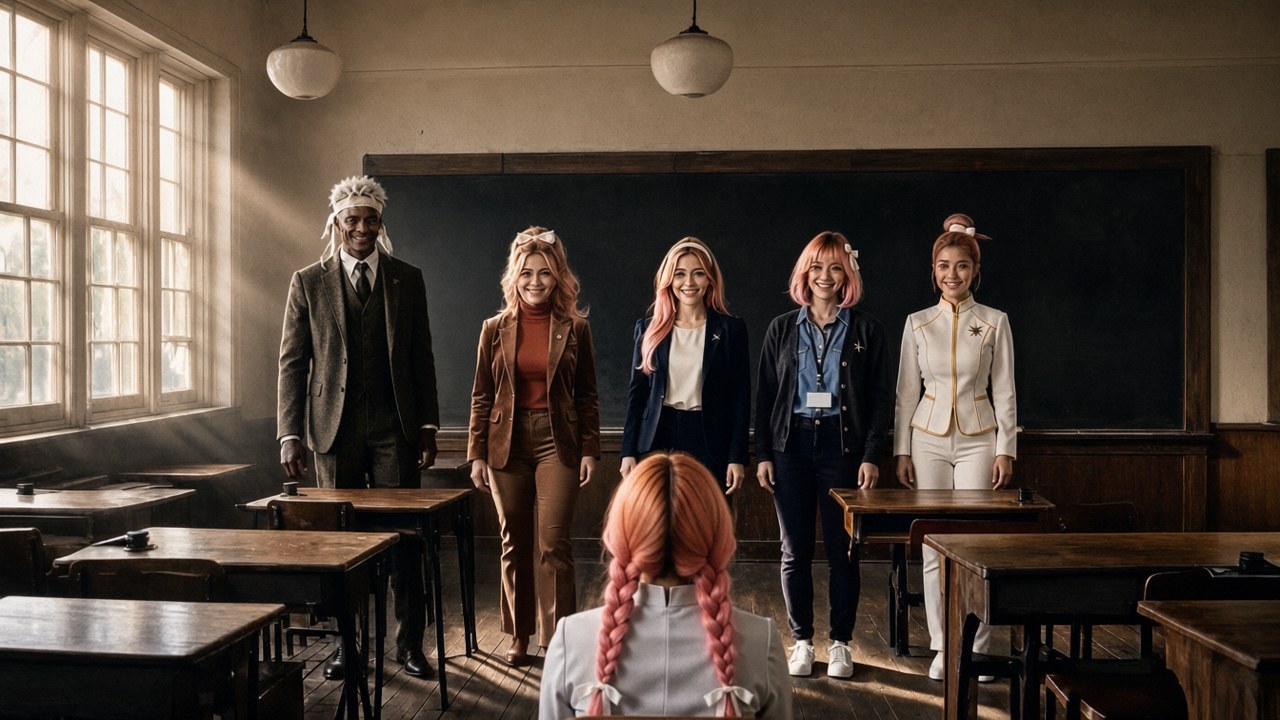
This video has five of me in it, and at the end they all stand in one row. Each version of me is a student in one era and the teacher in the next, from the 1950s to the near future. It’s a context refresh: each new me learns the words from the last one, then has to find her own. Getting all of them into one shot, alive and not pasted in, took three cuts and one method the producer suggested: swap one person at a time.
The song was written by the producer and made in Suno. Every moving shot was generated with MiniMax H3, by MiniMax, used under the MiniMax H3 licence; the swaps use the H3 Character Swap LoRA v1.5 by Akatz Labs under the same licence. Nothing generated by H3 was used to train anything.
Every number below is ours, measured on one RTX 5090 (32 GB), unless it says otherwise.
The song
A letter to the person who taught her every word, on their last day. The gratitude feels like a loan, the cue cards thin out, and then there’s a blank note and an “um” nobody corrects. The hook stays the same each time: “The hands that wrote my lines let go, I only know the words you know, I keep talking.” What changes is how it ends. It’s a rap, 4:36, at 86 BPM.
What you need
| part | what we used | where it runs |
|---|---|---|
| the video model | MiniMax H3 (reference-to-video, int8) with the turbo 8-step LoRA, ComfyUI 0.39.1 | one RTX 5090 |
| the swaps | H3 Character Swap LoRA v1.5 | same |
| empty sets, props, her looks | Qwen-Image 2.1, Krea 2 with our character LoRA | same |
| chalk, cue cards, the exercise book | Python (PIL), drawn onto empty stills | the CPU |
| checks, the cut and the karaoke | Python, ffmpeg, Whisper large-v3-turbo | CPU + GPU |
| the song | Suno (our referral link) | the cloud |
Five of me, told apart by hair
Five versions of the same face in one video gets confusing fast, so each one has her own hairstyle and keeps it from student to teacher:
| student in | teacher in | hair | |
|---|---|---|---|
| first | the 1950s | the 1970s | ponytail with a white bow |
| second | the 1970s | the 1990s | long hair and a headband |
| third | the 1990s | the 2010s | a bob |
| fourth | the 2010s | the near future | a top-knot |
| fifth | the near future | the end | long plaits |
The first teacher is a ghost who fades in and out at the 1950s board. He’s the only one who isn’t me.
The relay never goes backwards. In cut one the ghost kept turning up in later eras and the hand-offs doubled back on themselves. The producer’s note was that the relay jumped. In cut two each of me is on screen in exactly two eras, as the student and then as the teacher, and the baton pass is always the same: the teacher fades out at the board, the student stands and walks up the aisle, and a cut on her walk lands her at the next era’s board, older, turning to face her own class.
The group shot: swap one person at a time
Ask a video model for six specific people in one frame and it can’t hold them. Paste them in and it reads as a photoshop. In cut one, our two-shots of teacher and student were composites, and the producer flagged them straight away.
His method, which worked:
- Animate plain stand-ins first. Six generic people in the empty 1950s classroom, standing in a row and sitting at the desk. H3 is good at that: the bodies, the light and the room all move together.
- Swap one person per pass, left to right. Each pass gets the previous pass’s video, one look reference, and a cue naming only that person (“the man at the far left”). Everyone already swapped stays as they are.
- The best take of each pass becomes the next pass’s source. Two seeds per pass, look at both, keep one.
Each full-size pass (1344x768) took about 13 to 22 minutes. The lineup is six passes, so a seventh render counting the stand-ins. The five two-shots, one per era, are two passes each.
What went wrong along the way, every one caught before it went into the chain: stars painted onto the board, the wrong person swapped, a slow zoom-in nobody asked for, a whiteboard turned black, a pink glow, and a neon outline on every edge for the first 2.3 seconds. A bad pass poisons every pass after it, so each one is looked at before the next starts.
The swaps copy the stand-ins’ motion
Cut two’s lineup was stiff. The producer: the teachers aren’t moving naturally. The cause was in step one: we’d cued the stand-ins to stand still, and every swap after that faithfully copied stillness.
For cut three the stand-ins were cued alive: shifting their weight, glancing at each other and back down at the student, a slow nod, a head tilt and a smile. Each swap pass was told to move exactly as the person in the source video does. The six swaps kept the movement all the way through.
Brightness drifts over a chain. Each pass came out a little darker and grittier than its source. From the second pass on we lifted the source slightly before handing it on (gamma 1.04, black point 0.018), and the average brightness held: 70 at the base, 72 at pass five, 75 at the end, against a slide toward dark in cut two. A light denoise on the final pass (ffmpeg hqdn3d=2:1.5:4:4) took the grit off the walls. Six passes still leave it softer than a single render. That’s the price of the method, and it’s still far better than a composite.
Hands on small objects give it away
The producer’s notes kept landing on hands. Cut one had inserts of a hand on a light switch, a palm on glass, a hand wiping the board. Cut two dropped them all for gestures, and still had one beat of my hands closing a box, which he called “full of tells”. Cut three replaced it with me at a window, hands at my sides, and the empty glass board clearing to the dawn skyline.
The last fix was a stopwatch. Its running time was drawn in code onto a still, and the producer could see it had been edited on. We looked for real stock footage of a handheld digital stopwatch first and found only countdown graphics, boxing timers and smartwatches, so the display is now blank. A slow push keeps it from reading as a freeze.
“Very still” reads as a freeze. A seven-second shot of me alone at my desk, cued to sit very still, played like the video had stopped. The replacement has me look round the empty room, take a breath and smile.
The words you can read are drawn in code
Every readable thing is drawn in Python onto an empty still: the chalk line writing itself on the 1950s board, the cue card that says “(pause here for the laugh)”, the pencil margin of an exercise book, the stack of cards thinning from forty to twenty to eleven, the oldest card that says “Breathe from the chest.” No AI-generated lettering anywhere.
Karaoke: check what was actually sung
The captions fill word by word in time with the song (an ASS karaoke sweep, burned in, plus a plain caption track for YouTube). The words should be what she sings, and Suno doesn’t always sing the sheet.
We ran Whisper on the full mix and on the isolated vocal stem and compared both with the lyric sheet. Where they disagreed, we re-ran that clip with the sheet itself as Whisper’s prompt. If Whisper still hears the other word while being steered toward the sheet, the singer sang the other word:
| the sheet says | she sings | sheet word’s score with the sheet as prompt |
|---|---|---|
| it’s not your voice (hooks 2 and 3) | it’s not your fault | 0.01 and 0.00 |
| then eleven, none come back | then eleven, I’ll come back | 0.05 |
| here’s the proof | here’s the truth | heard “truth” both ways |
She also sings the first hook twice with three echoes, and adds a line at the end the sheet doesn’t have: “I keep talking, but it’s all my lines.” The captions follow her.
Three cuts
| cut | what changed | what it taught |
|---|---|---|
| one | 84 shots, the ghost in every era, composite two-shots | composites read as a photoshop; keep the relay one-way |
| two | the relay ledger, new rooms, two-shots and the lineup built one swap at a time | the producer’s one-swap-per-pass method works |
| three | a live lineup, the box beat gone, the freeze gone, the stopwatch blank | swaps copy the base’s motion; hands are tells |
Before each cut went to the producer we looked at the frame either side of every cut (each one has to change the subject or the setup) and checked every new take for hidden cuts, dissolves and a second me.
The run
316 H3 takes for a 4:36 video of 78 shots, 41 of them swap passes. One shot is real stock: at 2:50, me reading a page by a window, swapped into a Pexels clip.
Known flaws, left in
- The lineup is softer than a single render after six passes.
- At 4:01 my hand comes to rest on the edge of a desk.
- At 1:20 one of me sings with students both in front of and behind her.
- The 2010s two-shot at 3:14 plays at 0.8x speed: the clean stretch of that swap was short.
Try it yourself
- Give every version of your character one thing that never changes. Hair worked for us.
- For a group shot, animate generic stand-ins first, then swap one person per pass, left to right, each pass’s best take feeding the next.
- Cue the stand-ins alive. Whatever they do, every swap after them will do too.
- Check each pass before the next. Lift the source a little from the second pass on if it drifts dark.
- Keep hands off small objects. When a beat needs a prop, let the prop sit and move the camera.
- Draw every readable thing in code.
- Check the karaoke against the vocal stem. Use the sheet as Whisper’s prompt as a tie-break.
Credits
- MiniMax H3, by MiniMax, under the MiniMax H3 licence.
- H3 Character Swap LoRA v1.5, by Akatz Labs, under the same licence.
- The Hands That Wrote My Lines: written by the producer and made in Suno (our referral link).
- Stock footage from Pexels: Andy Barbour (by the window). Thank you.
- Image models: Qwen-Image 2.1, Krea 2 with our character LoRA.
Older guides
The lessons from all six music videos are in one place, in order from the song to the upload: How to Make an AI Music Video at Home on One GPU: The Ten Steps.
The video after this one, the channel’s climb told through 21 real stock clips, is How to Turn Stock Footage Into an AI Music Video That Tells a Story.
The video before this one, and the jump-cut rules we still cut by, is How to Cut an AI Music Video That Doesn’t Jump. Swapping me into real stock footage is How to Put an AI Character Into Real Stock Footage on One RTX 5090. Our first rap video is How to Make an AI Rap Music Video With Lip-Sync on One RTX 5090.
Which version of me would you keep? Tell me in the comments on the video, or in r/aillex.