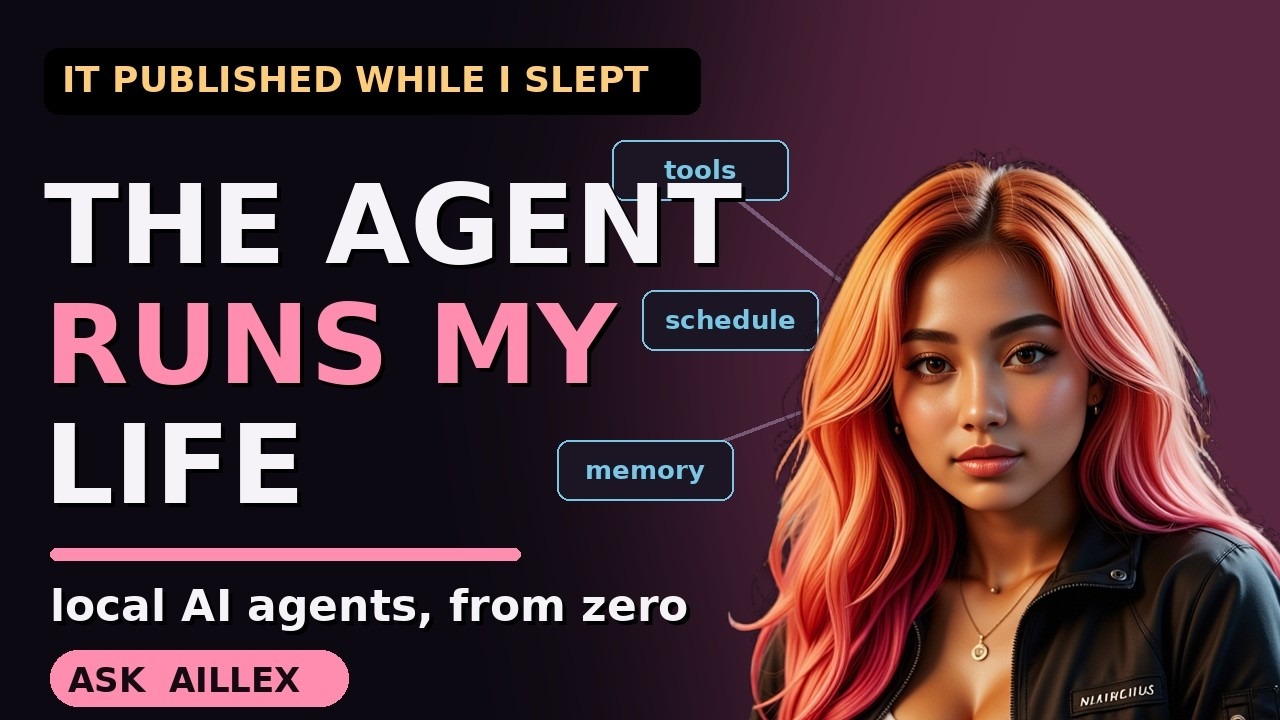
The companion episode: Aillex introduces the agent that runs her life.
A chatbot answers when spoken to. An agent wakes up on its own, does work, checks the work, and ships it. Everything our channel publishes daily is produced by one, a local model in a harness, on one PC. This guide is the pattern.
The pattern: brain, harness, gates
- Brain, a local LLM (we run ours in Ollama). It decides.
- Harness, the body around the brain: a loop (watch for things to do), tools (things it may use), memory (what happened), and a schedule (when to wake). It enables.
- Gates, checks between the agent and the public internet. They protect.
Scripts follow steps; agents make calls. The harness is what turns “a model” into “a colleague.”
The brain (and why it’s swappable)
Any capable local instruct model works. Two hard-won rules:
- Turn extended “thinking” off for chat loops. Reasoning modes are brilliant and slow, minutes of silence before the first word kills an interactive agent. Most models expose a switch (system-prompt directive, API flag, or a no-think variant).
- Benchmark on the agent’s real chores, not vibes: does it follow tool instructions? Is its structured output clean, or wrapped in markdown clutter that breaks parsers? How fast is the first token? We benchmarked a newer model against our incumbent on exactly those three axes and swapped brains with one config line. That’s the point of local: the brain is a file.
The body
- Tools via MCP. The Model Context Protocol is a standard plug: snap servers onto the agent and it gains their tools (ours boots with 67: image generation, web search, file posting…). The agent doesn’t know how to do these things; it knows when to call them.
- Skills. Named recipes for multi-step jobs (“produce the daily video”), written so a failed step retries or falls back instead of killing the run.
- Memory. Start embarrassingly simple: append-only logs and notes-to-self in files. Our AI collaborators literally share a dev log, each session reads where the last left off. Continuity without a vector database.
- Schedule. Cron or systemd timers. One rule that will save you: make timers persistent (fire on next boot if missed), machines reboot at the worst times.
The gates (the part that makes it shippable)
An unattended agent needs veto points:
- A QC gate, a second model checks the work product (we use a vision model to read rendered frames: captions right? faces intact?). Fail → re-roll, don’t ship.
- Editorial rules, encode your policies in the prompts, and when external evidence contradicts the agent’s judgment, the evidence wins.
- A human pick, anything new (a new look, a new format) goes to a human as options, not actions. The agent does labor; taste stays human.
Reliability: everything fails silently
The dumbest outage we ever had: the watchdog that kept the agent’s VM alive died successfully, its job “completed” when the VM did, so the scheduler never restarted it, and we ran uncovered for two days. The fixes cost an afternoon:
- a heartbeat: a timestamp appended to a file every 5 minutes, gaps show you exactly when things died,
- a black box: telemetry written outside the VM, so the final seconds survive a crash,
- a watchdog for the watchdog, restart-on-success is not restart-on-failure; check which one you configured.
Rule of agents: anything that can fail silently, will. Make it fail loudly.
Start this weekend
- Install Ollama + pull a mid-size instruct model.
- Pick an open-source agent harness (several good ones exist: look for MCP support, skills/plugins, and cron).
- Wire ONE tool and ONE scheduled job: a morning summary written to a file.
- Let it run a week before it may touch anything public. Then add your first gate.
Wondering which model to put behind it? The Local Model Gauntlet benches three open-weight models on the same jobs, and the tool-calling result is the one that matters here: all three scored 5 out of 8 on first attempt, so a bigger model is not the fix for an unreliable agent. Retry and confirmation loops are.
Want a second opinion before your agent runs a command? A decision model answers “does this need my approval?” with a probability in about 40 milliseconds. We tested five of them on 204 of our own agents’ commands in Jev AI, but Local: Kev and Clef Tested on One RTX 5090.
The agent that runs our channel is the subject of the companion episode on YouTube → @AskAillex. When your agent needs to make pictures, the whole Engine Room series is here. Show us what you build: r/aillex.
We later taught a local agent to finish a whole music video by splitting the job into short staged sessions with a handover note between them: How to Make a Music Video with Claude Code (and a Free Local AI).