
Every edit in this series is the same nine nodes. Learn this graph once and the rest of the guides are small variations on it.
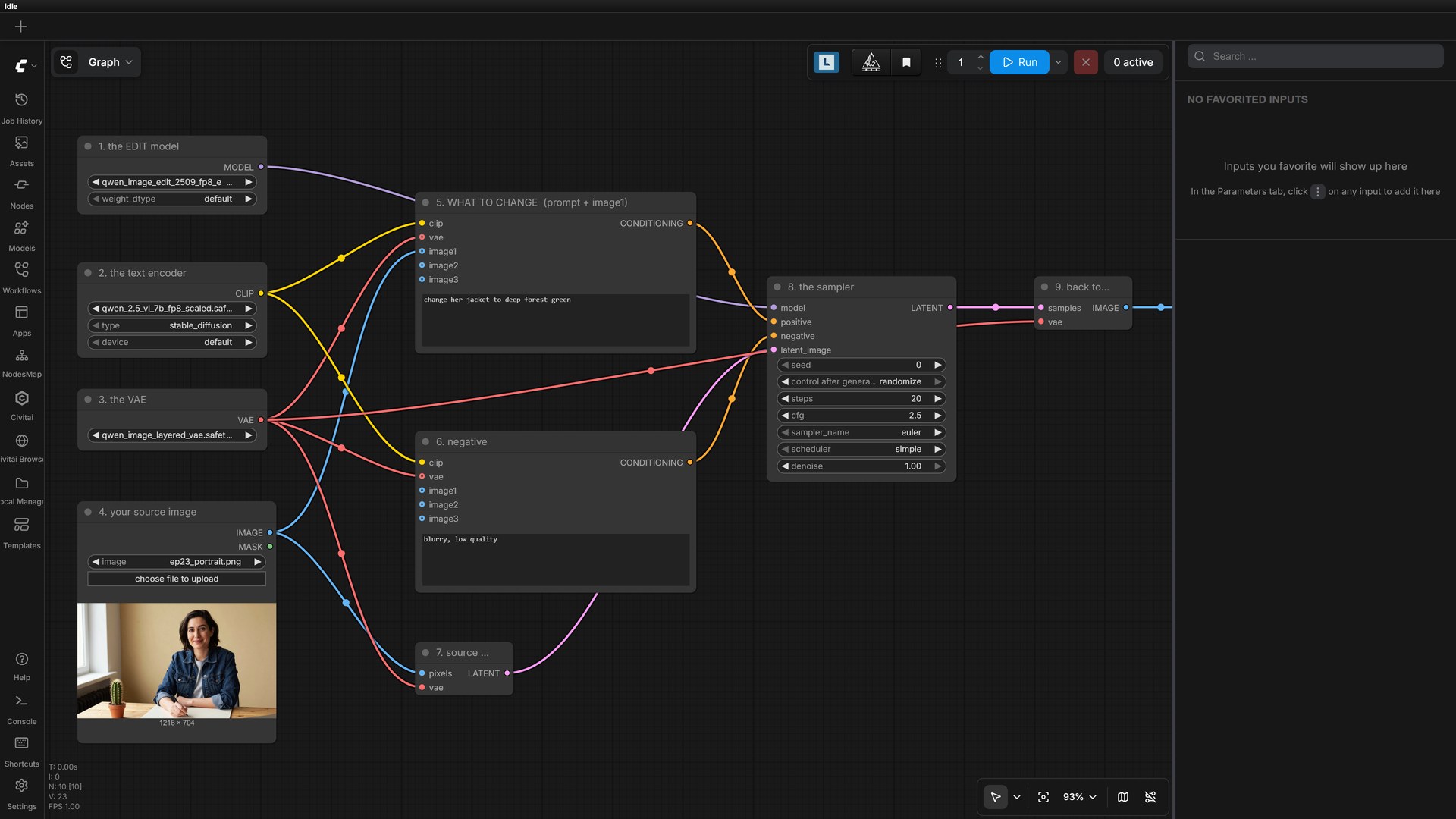
That’s the entire thing. The numbered titles map to what each box is for:
| # | Node | What it does |
|---|---|---|
| 1 | UNETLoader | The edit model itself (qwen_image_edit_2511). |
| 2 | CLIPLoader | The text encoder that reads your instruction. |
| 3 | VAELoader | Translates between pixels and latents. |
| 4 | LoadImage | Your source photo. |
| 5 | TextEncodeQwenImageEditPlus | The important one, prompt and image go in together. |
| 6 | same node, negative | What you don’t want. |
| 7 | VAEEncode | Your source becomes the starting latent. |
| 8 | KSampler | Does the work. |
| 9 | VAEDecode → SaveImage | Back to pixels, written to disk. |
Follow-up, September 2026: we re-ran this on five current editors, took two people out of a group photo, and took back one thing this guide’s era said was impossible. Read Remove People From a Photo With Free Local AI and the companion piece on why editors keep faces and lose bodies.
The node that makes it an edit
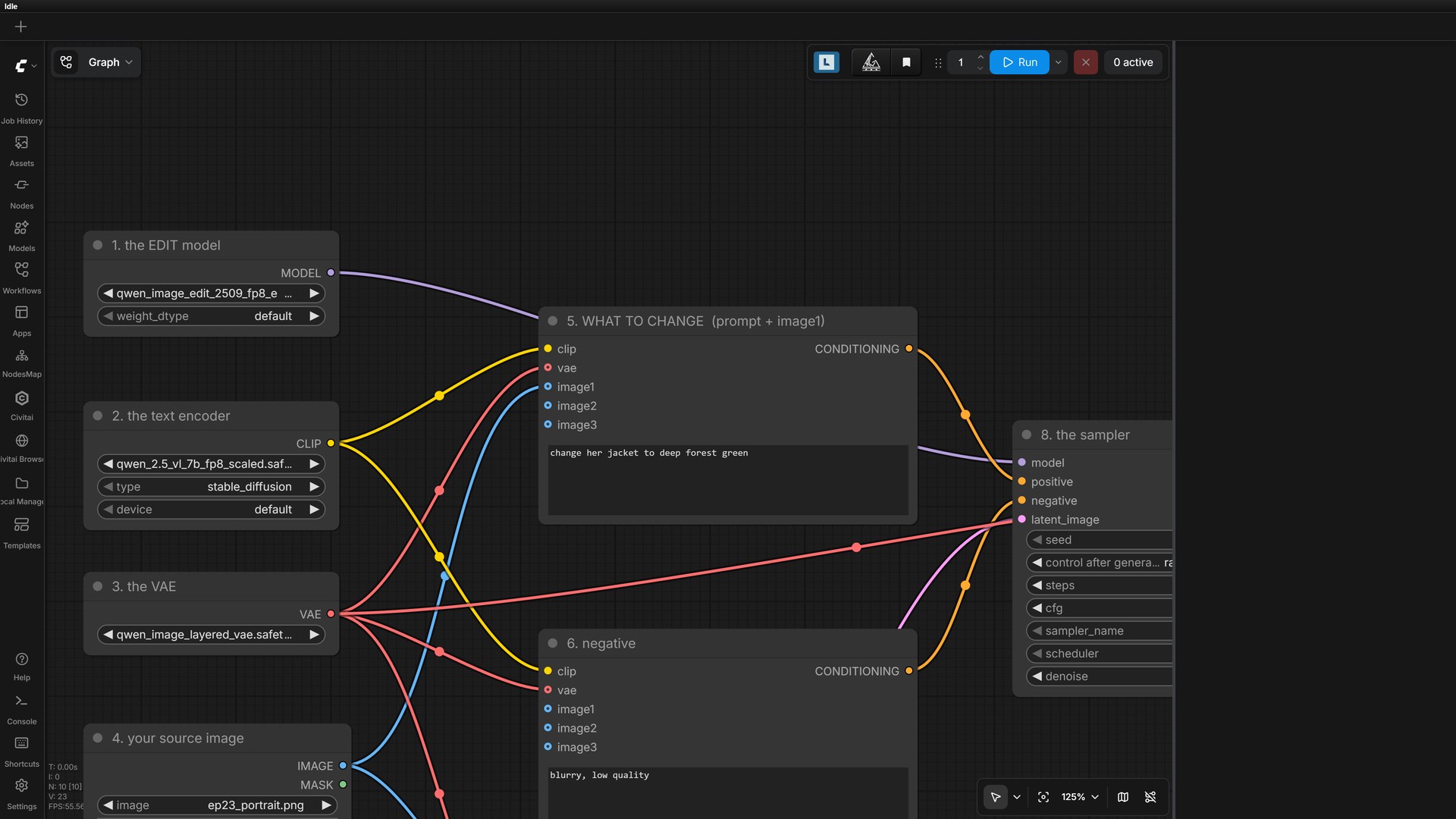
TextEncodeQwenImageEditPlus is what separates editing from generating. A normal text-to-image graph
encodes only words. This node takes your instruction and up to three reference images on the
image1 / image2 / image3 inputs, so the model is conditioned on what your picture actually
contains, not just on a description of it.
Wire image1 to your LoadImage, type the change you want in plain English, and that’s an edit:
change her jacket to deep forest green
No mask. No selection. No layer. The model works out what “her jacket” refers to.
Measured: 57 seconds on an RTX 5090 for a full-quality pass at these settings.
What it’s good at, and what it isn’t
Whole-object changes are its strength: garments, colours, materials, lighting. It struggles with fine
asymmetric control (a wink, one raised eyebrow); it repaints the state of a face rather than nudging a
single muscle. For that you want a reference image on image2, not a better sentence.
The settings, and what each one actually does
Four numbers in the KSampler carry an edit. These are the values we ran for every result below.
| Field | Value | Why |
|---|---|---|
steps | 20 | Below about 12 it stops respecting the instruction properly. |
cfg | 2.5 | The one people get wrong. On an edit model, high CFG doesn’t mean “obey me more”, it means “destroy the original.” Stay between 2 and 3. |
sampler_name | euler | Boring and reliable. |
scheduler | simple | Same. |
denoise | 1.0 | Surprising, but correct here: the encoder holds your original, not the noise level. |
seed | change it | When an edit half-works, same prompt + new seed is free. |