
This is the one that made us stop and re-run it to be sure. One generation returns the flat image, every object cut out on true alpha, and a clean background plate with the objects removed and the wall rebuilt behind them.
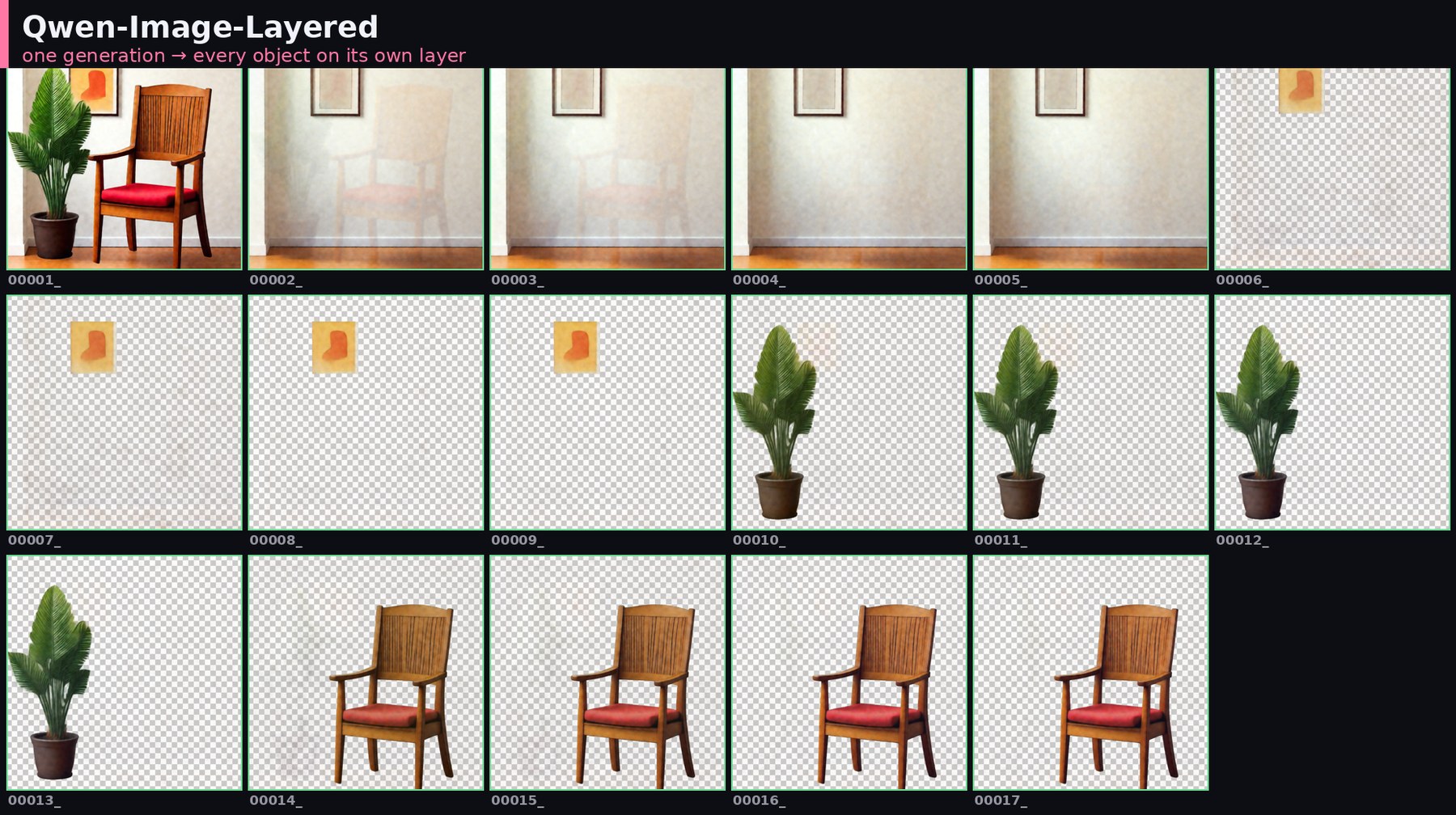
layers=4 produced 17 images in 148 seconds: the composite, a background plate, and each object
isolated: chair, plant, framed picture, on transparency.
That background plate is the part worth pausing on. It’s automatic object-removal and inpainting, free, as a side effect of generating. Normally that’s a separate masked job per object.
The graph
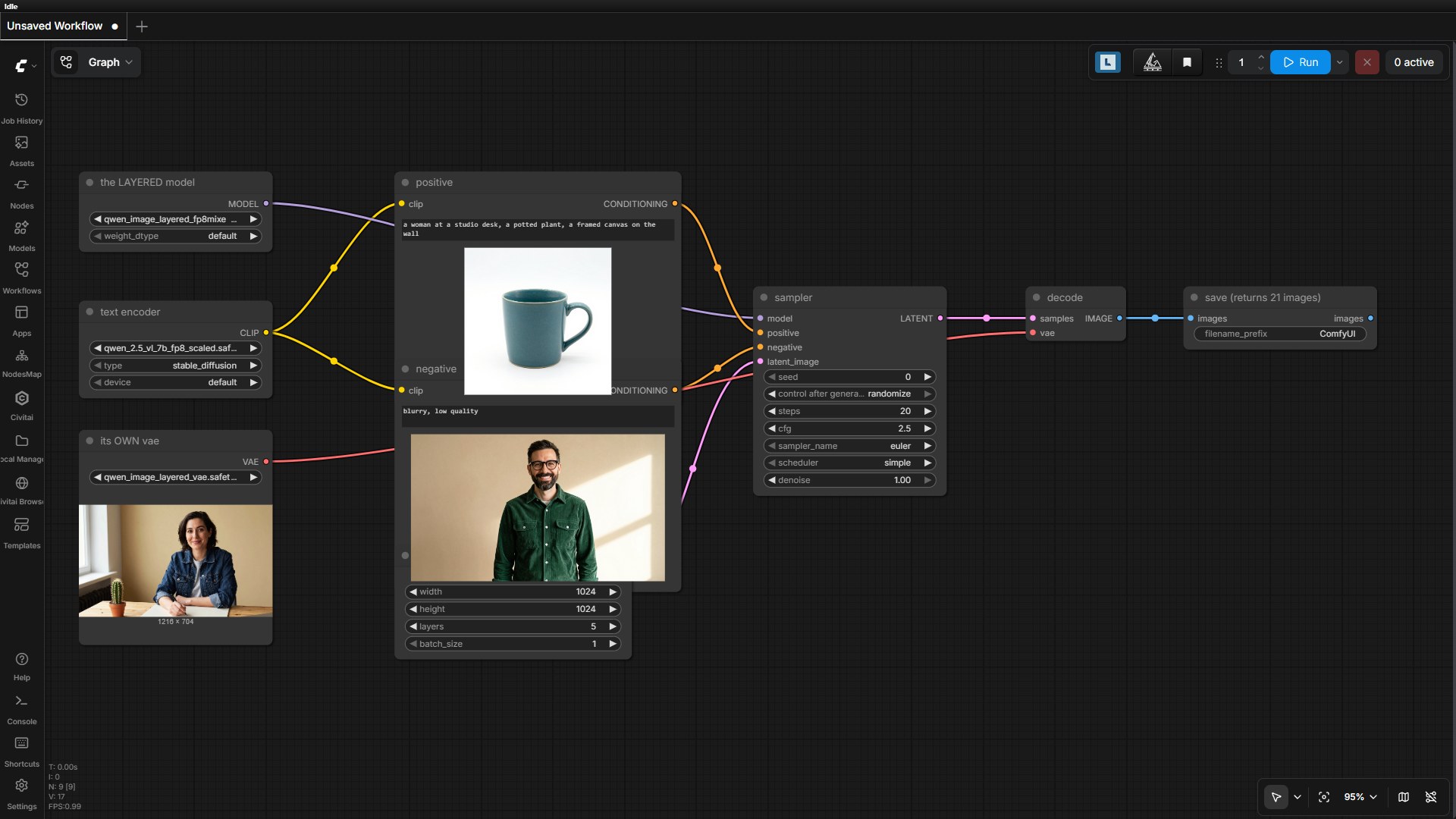
It’s the standard text-to-image shape with two swaps: the layered UNet, its own matching VAE, and one different latent node.
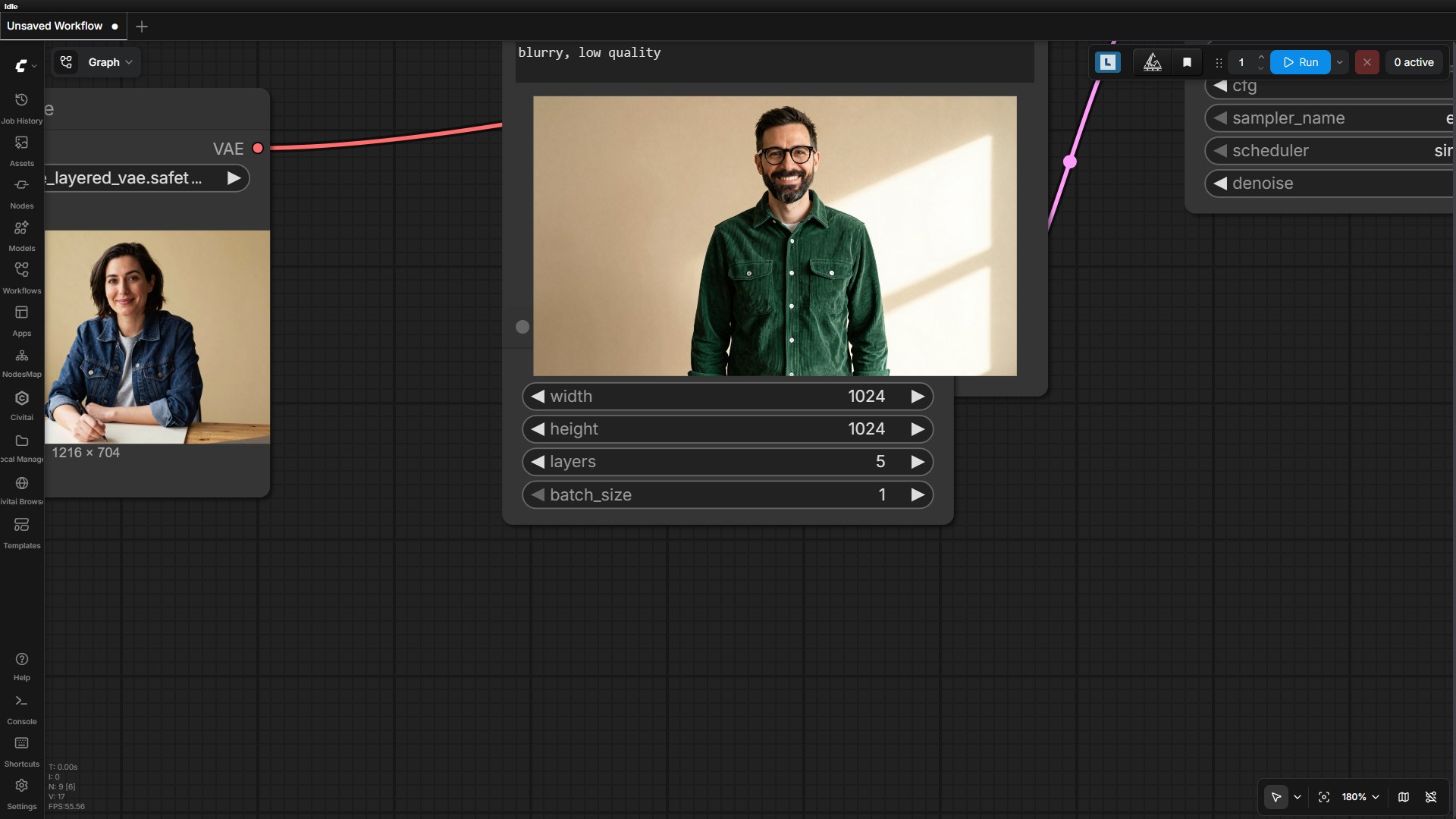
| Field | Value | Notes |
|---|---|---|
width / height | 1024 | Standard. |
layers | 5 | This is the whole trick, how many pieces you get back. |
batch_size | 1 | Leave it. |
The layer count lives in the latent shape, which is why this is a different node rather than a checkbox. Everything downstream: KSampler, VAEDecode, SaveImage, is unchanged.
The catch, stated plainly
It generates in layers. It does not take a photo you already have and pull it apart.
We tested that specifically, encoding a real photo through the layered VAE and sampling at denoise 1.0 and again at 0.75. Both returned a single flat image. A batch-expansion route ran out of memory. The supported path is text → layered generation, full stop.
Cost
The full build is a ~20 GB model plus a 243 MB VAE, and it peaked near 29 GB of VRAM here. A GGUF Q4 quantisation reportedly fits in 8 GB, check that first if you’re on a smaller card, because this is a big download to discover you can’t run.
The settings, and what each one actually does
Four numbers in the KSampler carry an edit. These are the values we ran for every result below.
| Field | Value | Why |
|---|---|---|
steps | 20 | Below about 12 it stops respecting the instruction properly. |
cfg | 2.5 | The one people get wrong. On an edit model, high CFG doesn’t mean “obey me more”, it means “destroy the original.” Stay between 2 and 3. |
sampler_name | euler | Boring and reliable. |
scheduler | simple | Same. |
denoise | 1.0 | Surprising, but correct here: the encoder holds your original, not the noise level. |
seed | change it | When an edit half-works, same prompt + new seed is free. |