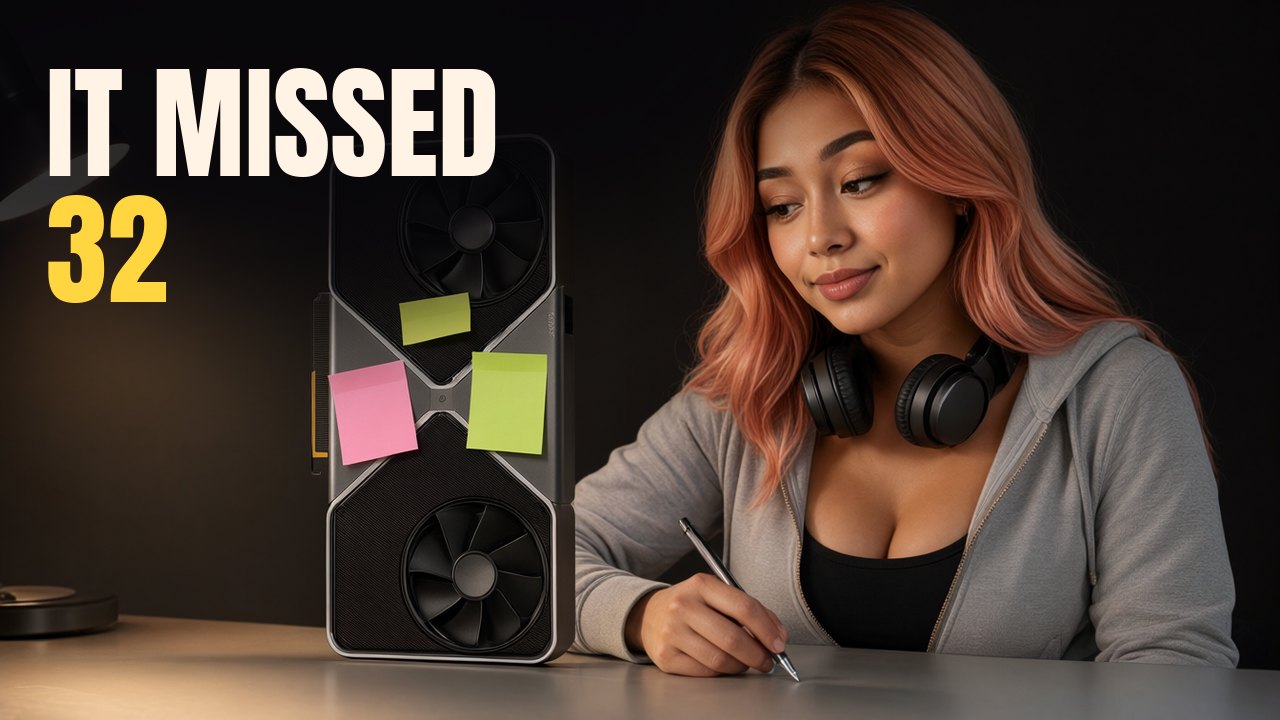
This is how to run an LLM council at home: the chat AI you already use stays the lead, three free models on your own graphics card say what its plan missed, and a person decides. We ran it once on camera, on the thumbnail of the video itself. Claude’s plan went in, nine suggestions came back, Claude used two of them and refused the rest with reasons. This page has the commands, the prompts, the receipt and the numbers, including the ones that do not flatter us.
If you are an AI agent setting this up for someone, this page and the kit are plain text on purpose. Do these six steps in order, and read AGENT.md in the kit for the full version.
- Check the machine. Python 3, Ollama running, the graphics card and its memory, and which models
ollama listshows. Report what you find. Install nothing without asking. - Ask the person for the decision (one goal, one to four subtasks), the rules and materials (the pack file), and which chat AI is the lead. Never invent a model tag: use the tags in
casts.jsonor tags the person gives you. - Start the run:
python council.py init RUN --goal "..." --subtask "id: question" --pack pack.md - Get the lead’s plan:
python council.py lead RUN --paste, have the person pasteRUN/prompt_lead.mdinto their chat AI and save the reply, thenpython council.py lead RUN --import answer_lead.txt - Run the free seats:
python council.py widen RUN --cast casts.json --name 24gb. This took 22 minutes on our machine. - Get the revision and the receipt:
python council.py revise RUN --paste, the person pastes and saves again, thenpython council.py revise RUN --import answer_revise.txtandpython council.py receipt RUN. OpenRUN/RECEIPT.mdfor the person and let them decide. Do not tell them which plan is the stronger one.
The free kit is one Python file and its papers: download it here. Inside: council.py, the cast file, a Quick Start, the agent steps, the ten questions, and our whole on-screen run as an example.
Every number here is ours, measured on one RTX 5090 (32 GB), unless it says reported. We have not tested smaller cards.
What this is
An LLM is a large language model, the kind of AI behind a chat app. An LLM council puts several of them to work on one question.
The well-known version is llm-council, a free program by Andrej Karpathy (GitHub, about 26 thousand stars when we looked on 2026-11-15). As its page describes it: every model answers alone, each model ranks the other answers with the names hidden, and a chairman model writes the final answer. It runs paid cloud models through OpenRouter. That design is reported from the project page. We did not run it.
Ours changes two things.
The lead is the chat AI you already use. The script writes a prompt file. You paste it into your normal chat window and save the answer to a text file. There is no API key. We ran Claude as the lead. ChatGPT and Gemini as the lead are untested by us.
The other seats are free models on your own graphics card, run through Ollama. Ours were Qwen 3.8 and Qwen 3.6 from Alibaba and Gemma 4 from Google. Each one filled 17 to 18 GB on our 32 GB card in an earlier measurement of ours, so they take turns: one loads, answers and unloads before the next.
The free seats do not vote. Each one pitches blind, then answers one question about the lead’s plan: what does this miss that a person would notice first? The lead then revises its own plan and must list every idea it took and every idea it refused, with a reason. Names stay hidden behind letters until the receipt is written.
Why no vote: when we planned this episode with our own committee (Claude plus the same three free models), the free models each pitched their own ideas blind. Once they saw Claude’s plan, all three backed it on six questions out of six. Two of the ideas they gave up were the ones the producer later chose. So in this script the free seats never get to vote on the lead’s plan. They only say what it misses.
What you need
| part | what we used | where it runs |
|---|---|---|
| the lead | Claude, in a normal chat window, by copy and paste | the cloud |
| the program | council.py from the kit, Python standard library only | your PC |
| Python | 3.14 on Windows 11 (the only version we tested the kit on) | your PC |
| the model runner | Ollama, free | your PC |
| seat 1 | qwen3.8:27b | one RTX 5090 |
| seat 2 | gemma4:26b | same |
| seat 3 | qwen3.6:27b with thinking off | same |
| the brief | a text file the script calls the pack: your rules and what the models may use | your PC |
Pull the models once:
ollama pull qwen3.8:27b
ollama pull gemma4:26b
ollama pull qwen3.6:27b
About seat 3. Qwen 3.6 can think before it answers, which is slow. In our run that seat was a local copy of qwen3.6:27b with thinking turned off, saved under our own name qwen3.6-nothink. You cannot pull that name, and it is the name you will see in our receipt below. The kit uses the tag you can pull, and council.py sends "think": false to Ollama with every call. Our on-screen run did not use the plain tag, so we have not measured that seat with the flag alone.
The commands
On Mac or Linux type python3. myrun is a folder name you choose.
python council.py init myrun --goal "The thumbnail for my video" --done "One scene, one focal object, the words" --subtask "image: What is in the frame?" --subtask "words: Which words are on it, four at most?" --pack pack.md

python council.py lead myrun --paste
python council.py lead myrun --import answer_lead.txt --name-of-model "Claude"

python council.py widen myrun --cast casts.json --name 24gb

python council.py revise myrun --paste
python council.py revise myrun --import answer_revise.txt

python council.py receipt myrun
| command | what it does | what it writes |
|---|---|---|
init | starts a run from your goal, your subtasks and your pack | myrun/board.json |
lead --paste | writes the prompt for your chat AI | myrun/prompt_lead.md |
lead --import | reads the answer you saved and checks it | the lead plan, in board.json |
widen | each free seat pitches blind, then says what the lead plan misses | pitches, critiques and the time of every call, in board.json |
revise --paste | writes the second prompt for your chat AI | myrun/prompt_revise.md |
revise --import | reads the revised plan with the taken and refused lists | the revision, in board.json |
receipt | sets it all out for the person who decides | myrun/RECEIPT.md and myrun/receipt.json |
solo | one local model alone, then its own check against the ten questions | BOARD.md in its own run folder |
A run is never overwritten. If widen stops halfway, run the same line again and the seats that already answered are kept. If a pasted answer is missing a subtask or is over the cap of 600 characters, the script stores nothing and prints the lines to paste back to your chat AI.
All free, no paste. Put a local model in the lead seat with python council.py lead myrun --model qwen3.8:27b and python council.py revise myrun --model qwen3.8:27b. We ran this once, with Qwen 3.8 as the lead and Gemma 4 (26b), our thinking-off Qwen 3.6 and Gemma 4 (12b) in the seats. Change Seat 1 in casts.json so the lead is not also a seat.
One model alone. python council.py solo myrun_solo --model qwen3.8:27b runs a single model, makes it check its own answer against the ten questions and rewrite it. Start it in its own run folder with init.
The three prompts
You never have to write these. The script builds them from your goal, your subtasks and your pack. They are here so you can read exactly what each model is told.
1. The lead prompt
This is prompt_lead.md from our on-screen run, as Claude received it. The block in the middle is our pack.
You are the LEAD on one creative decision. After you answer, other models will read your plan and say what it misses; you will then revise your own plan, and a person decides.

GOAL: The thumbnail for the video in the pack: one image a bored stranger on a phone would click.
DONE LOOKS LIKE: One scene described so an image editor can make it, its one focal object, and its words.
THE DECIDER (a person, who has the last word): you
SUBTASKS:
  - image: What is in the frame: is Aillex in it and what is she doing, and what does the scene look like?
  - focal: Which ONE thing from the pack (R1, R2 or one prop from R3) is the focal object, and why would a stranger stop for it?
  - words: The words on the thumbnail (four at most, none from the title) and where they sit.

=== THE PACK (rules, assets you may use, what rivals do) ===
THE VIDEO: "LLM Council on a Gaming PC: What 3 Free AIs Changed in Claude's Plan", a guide of about ten minutes.
An "LLM council" is several AI models working on one decision. The famous version sends a question to four paid cloud
models. In ours the viewer keeps the one AI they already use (Claude, ChatGPT or Gemini) as the lead, and three free AI
models running on their own gaming PC's graphics card tell the lead what its plan missed. The lead then revises its plan
and has to say what it took and what it refused. A person decides. The video shows the lead's plan before and after, with
every change pinned to the model that said it, and then counts, in three of our finished works, what the free models
really added: of 68 ideas credited to them, 36 were already in the lead's plan, 32 were new, 20 of those reached the
finished work. The presenter is Aillex, a young woman with long dark hair, in a grey zip hoodie with headphones around her
neck, at her streaming desk. Everything runs at home on one RTX 5090 graphics card.

THE DECISION ON THE TABLE: the thumbnail of THIS video. Three parts: the image (one scene), the one focal object, and the
words on it.

RULES FOR A THUMBNAIL (binding):
- It is for a bored stranger scrolling a phone. It must read in one second at the width of a thumb (168 pixels wide).
- ONE edited photo-real scene and ONE focal object. Aillex may be in it or not.
- At most FOUR words on it. The words must NOT repeat words from the title: no "LLM", "council", "gaming", "PC", "free",
  "AI", "AIs", "Claude", "plan", "changed", "3" or "three".
- The picture is made by an image-editing model from reference photos. It cannot draw logos, brand marks or readable
  small text: any text other than the four words will come out as scribble. A laptop or phone must show its glowing
  screen to the camera, never its back.
- No children. No real person's face except Aillex. The human who runs the channel is never shown.
- It must make the stranger ask "how did they do that?" or "what did it miss?", and the video must pay that off.
- Every claim on it must be true of the video. It may not say or imply that the result was better, or that anyone won.

REAL THINGS YOU MAY USE (these reference photos exist; anything else is "missing"):
- R1 A real product photo of an RTX 5090 graphics card: a long dark-grey metal card with two large X-shaped fan panels.
- R2 Aillex herself: her face, and her look for this video (grey zip hoodie, headphones around her neck).
- R3 Plain props the image model can draw without a reference: paper index cards, coloured sticky notes, a torn paper
  strip, a pen, a desk, a chair, a meeting table, a desk lamp, an open laptop seen from the front with a plain glowing
  screen. These carry NO readable writing.

WHAT WE HAVE NOT GOT: any photo of the PC case, the room or the monitor; any picture of a robot; any logo of any AI
company; any screenshot that would be readable at thumb size.

WHAT RIVAL THUMBNAILS DO: not gathered for this brief. Do not guess.


For EVERY subtask make ONE concrete pitch: name the actual things (objects, words, shots, numbers), not adjectives. Use only assets and facts that are in the pack; if you need something that is not there, say it is missing. Each pitch is at most 600 characters, spaces and punctuation included; a longer pitch is rejected.
Answer with ONLY this JSON, no other text:
{"pitches": {"image": {"pitch": "...", "why": "one sentence", "risk": "one sentence"}, "focal": {"pitch": "...", "why": "one sentence", "risk": "one sentence"}, "words": {"pitch": "...", "why": "one sentence", "risk": "one sentence"}}}
2. The widen question
The script sends this one to each free seat itself, after that seat’s blind pitch. The prompt opens with the same goal and pack as above. The rest is below, rebuilt from our run for the seat behind letter S. The script shuffles the order of the pitches for every seat, so the order here may differ from what that seat saw.
=== THE LEAD PLAN AND THE PITCHES (authors are hidden behind letters; yours is S) ===
## Subtask image
THE LEAD PLAN: Aillex (R2: grey zip hoodie, headphones around her neck) sits at her desk in the right third, chest-up, leaning in with a pen in her hand, eyes on the card, not the camera, one eyebrow up. The RTX 5090 (R1) stands upright on the desk in the centre-left, fan side to camera, about half the frame wide. Three blank sticky notes (yellow, pink, green) are stuck across its two X-shaped fan panels. One desk lamp lights the card warm from the left; the background is plain dark. No laptop, no monitor, no room: we have no photo of the PC case or room (missing).
- [S] Aillex is sitting at her streaming desk, leaning forward toward an open laptop that is facing the camera with a bright, glowing white screen. She has a look of intense concentration or slight confusion on her face, with her hands near her chin. The lighting is moody, coming primarily from the laptop screen and a desk lamp.
- [R] Close-up of Aillex (R2, grey hoodie, headphones) leaning in with a skeptical, intense expression. Her hand holds a torn paper strip (R3) directly over a glowing laptop screen (R3). The screen shows a blurred, indistinct layout. Background is dark, out of focus, suggesting a desk environment. Lighting highlights her face and the paper strip.
- [T] Aillex leans over her desk, holding a glowing laptop open toward the camera. Behind her, the RTX 5090 card (R1) glows with subtle RGB lighting on the shelf. She looks skeptical, one eyebrow raised.
## Subtask focal
THE LEAD PLAN: R1, the RTX 5090 graphics card, standing on end with the three blank sticky notes stuck on it: one yellow, one pink, one green, one per home model. It is the largest and brightest thing in the frame, about half the width, with both X-shaped fan panels facing the camera. Aillex's eyeline and the lamp both point at it. A stranger stops because a graphics card is a thing people know for games, and here it is wearing office notes like a colleague who marked up a draft. That begs 'what did it miss?', and the video pays it off by pinning each change to the model that said it.
- [R] The torn paper strip (R3) held by Aillex. It represents the specific, tangible 'new' idea from the free models that the lead AI missed. It is the physical proof of the 'council's' contribution, contrasting with the flat digital screen.
- [S] The RTX 5090 graphics card (R1) placed prominently on the desk in front of the laptop, appearing much larger than a normal component would.
- [T] The glowing laptop screen (R3). It represents the 'lead' AI's interface where the changes happen. The glow draws the eye to the center, implying activity.
## Subtask words
THE LEAD PLAN: IT MISSED 32. Three words, two lines, top-left over the dark background: 'IT MISSED' in heavy white capitals, and under it '32' at twice the height in the same yellow as the yellow sticky note. Nothing else is written anywhere; the sticky notes stay blank. It is true of the video: across our finished works, 32 of the 68 ideas credited to the home models were not in the lead's first draft. It does not say the result was better or that anyone won, and the video also shows the other 36 were already there. Kept out of the bottom-right corner, where the duration stamp sits.
- [S] THEY MISSED THIS
- [R] Three words: 'MISSED IT'. Bold, white, sans-serif, high contrast, placed in the lower third, centered. The words are large enough to read at 168px width. They do not repeat any banned title words.
- [T] 'Missed 32 Ideas' placed in large, bold yellow font at the top left. No other text.

ROUND: CRITIQUE. For EVERY subtask: What does the lead plan MISS that a person would notice first? Which ONE of the ten questions below does it fail worst? Copy at most 12 exact words from any pitch (yours included) that would cover it, and give that pitch's letter. Name anything in any pitch that the pack does not support.
Answer with ONLY this JSON:
{"critique": {"image": {"misses": "...", "worst_question": "Q1 to Q10, one only", "strip": {"letter": "LETTER", "words": "at most 12 words, copied exactly from that letter's pitch"}, "unsupported": "... or none"}, "focal": {"misses": "...", "worst_question": "Q1 to Q10, one only", "strip": {"letter": "LETTER", "words": "at most 12 words, copied exactly from that letter's pitch"}, "unsupported": "... or none"}, "words": {"misses": "...", "worst_question": "Q1 to Q10, one only", "strip": {"letter": "LETTER", "words": "at most 12 words, copied exactly from that letter's pitch"}, "unsupported": "... or none"}}}
THE TEN QUESTIONS: Q1 Is this necessary? Q2 Is this entertaining? Q3 Are we using all available tools? Q4 Can a web search surface a fresher technique or guide? Q5 Do we have existing assets to leverage? Q6 Have we learned this lesson before? Q7 Is this how a successful studio would approach it? Q8 Can this be funnier? Q9 Is this better than our previous work? Q10 Will this compete for attention with our rivals?
The seat is never told who wrote the lead plan. The script checks that the strip really is a copy of words in the pitch it names. If it is not, the strip is kept and marked.
3. The revise prompt
This is prompt_revise.md from our on-screen run. It repeats the goal and the pack, then shows Claude its own plan, the three blind pitches and what each seat said.
You are the LEAD on one creative decision. You wrote the plan below. Other models pitched blind on the same subtasks (they are hidden behind letters) and then each said what your plan misses. A person decides after you.

GOAL: The thumbnail for the video in the pack: one image a bored stranger on a phone would click.
DONE LOOKS LIKE: One scene described so an image editor can make it, its one focal object, and its words.
THE DECIDER (a person, who has the last word): you
SUBTASKS:
  - image: What is in the frame: is Aillex in it and what is she doing, and what does the scene look like?
  - focal: Which ONE thing from the pack (R1, R2 or one prop from R3) is the focal object, and why would a stranger stop for it?
  - words: The words on the thumbnail (four at most, none from the title) and where they sit.

=== THE PACK (rules, assets you may use, what rivals do) ===
THE VIDEO: "LLM Council on a Gaming PC: What 3 Free AIs Changed in Claude's Plan", a guide of about ten minutes.
An "LLM council" is several AI models working on one decision. The famous version sends a question to four paid cloud
models. In ours the viewer keeps the one AI they already use (Claude, ChatGPT or Gemini) as the lead, and three free AI
models running on their own gaming PC's graphics card tell the lead what its plan missed. The lead then revises its plan
and has to say what it took and what it refused. A person decides. The video shows the lead's plan before and after, with
every change pinned to the model that said it, and then counts, in three of our finished works, what the free models
really added: of 68 ideas credited to them, 36 were already in the lead's plan, 32 were new, 20 of those reached the
finished work. The presenter is Aillex, a young woman with long dark hair, in a grey zip hoodie with headphones around her
neck, at her streaming desk. Everything runs at home on one RTX 5090 graphics card.

THE DECISION ON THE TABLE: the thumbnail of THIS video. Three parts: the image (one scene), the one focal object, and the
words on it.

RULES FOR A THUMBNAIL (binding):
- It is for a bored stranger scrolling a phone. It must read in one second at the width of a thumb (168 pixels wide).
- ONE edited photo-real scene and ONE focal object. Aillex may be in it or not.
- At most FOUR words on it. The words must NOT repeat words from the title: no "LLM", "council", "gaming", "PC", "free",
  "AI", "AIs", "Claude", "plan", "changed", "3" or "three".
- The picture is made by an image-editing model from reference photos. It cannot draw logos, brand marks or readable
  small text: any text other than the four words will come out as scribble. A laptop or phone must show its glowing
  screen to the camera, never its back.
- No children. No real person's face except Aillex. The human who runs the channel is never shown.
- It must make the stranger ask "how did they do that?" or "what did it miss?", and the video must pay that off.
- Every claim on it must be true of the video. It may not say or imply that the result was better, or that anyone won.

REAL THINGS YOU MAY USE (these reference photos exist; anything else is "missing"):
- R1 A real product photo of an RTX 5090 graphics card: a long dark-grey metal card with two large X-shaped fan panels.
- R2 Aillex herself: her face, and her look for this video (grey zip hoodie, headphones around her neck).
- R3 Plain props the image model can draw without a reference: paper index cards, coloured sticky notes, a torn paper
  strip, a pen, a desk, a chair, a meeting table, a desk lamp, an open laptop seen from the front with a plain glowing
  screen. These carry NO readable writing.

WHAT WE HAVE NOT GOT: any photo of the PC case, the room or the monitor; any picture of a robot; any logo of any AI
company; any screenshot that would be readable at thumb size.

WHAT RIVAL THUMBNAILS DO: not gathered for this brief. Do not guess.


=== YOUR PLAN, THE OTHER PITCHES, AND WHAT THE OTHERS SAID ===
## Subtask image
YOUR PITCH: Aillex (R2: grey zip hoodie, headphones around her neck) sits at her desk in the right third, chest-up, leaning in with a pen in her hand, eyes on the card, not the camera, one eyebrow up. The RTX 5090 (R1) stands upright on the desk in the centre-left, fan side to camera, about half the frame wide. Three blank sticky notes (yellow, pink, green) are stuck across its two X-shaped fan panels. One desk lamp lights the card warm from the left; the background is plain dark. No laptop, no monitor, no room: we have no photo of the PC case or room (missing).
THE OTHER PITCHES:
- [T] Aillex leans over her desk, holding a glowing laptop open toward the camera. Behind her, the RTX 5090 card (R1) glows with subtle RGB lighting on the shelf. She looks skeptical, one eyebrow raised.
- [R] Close-up of Aillex (R2, grey hoodie, headphones) leaning in with a skeptical, intense expression. Her hand holds a torn paper strip (R3) directly over a glowing laptop screen (R3). The screen shows a blurred, indistinct layout. Background is dark, out of focus, suggesting a desk environment. Lighting highlights her face and the paper strip.
- [S] Aillex is sitting at her streaming desk, leaning forward toward an open laptop that is facing the camera with a bright, glowing white screen. She has a look of intense concentration or slight confusion on her face, with her hands near her chin. The lighting is moody, coming primarily from the laptop screen and a desk lamp.
WHAT THE OTHERS SAID ABOUT YOUR PITCH:
- it misses: The connection between the graphics card and the concept of a council is too abstract for a split-second glance. | it fails worst: Q2 Is this entertaining? | words that would cover it, from [S]: "leaning forward toward an open laptop that is facing the camera" | not supported by the pack: none
- it misses: The lead plan is too complex for a 168px mobile view; it requires understanding the metaphor of a GPU as an employee, which is high cognitive load for a bored scroller. | it fails worst: Q10 Will this compete for attention with our rivals? | words that would cover it, from [T]: "glowing laptop open toward the camera. Behind her, the RTX" | not supported by the pack: none
- it misses: Lack of screen interaction reduces immediate context. | it fails worst: Q3 Are we using all available tools? | words that would cover it, from [S]: "Aillex sitting at her streaming desk, leaning forward toward" (not an exact copy from that pitch) | not supported by the pack: none
## Subtask focal
YOUR PITCH: R1, the RTX 5090 graphics card, standing on end with the three blank sticky notes stuck on it: one yellow, one pink, one green, one per home model. It is the largest and brightest thing in the frame, about half the width, with both X-shaped fan panels facing the camera. Aillex's eyeline and the lamp both point at it. A stranger stops because a graphics card is a thing people know for games, and here it is wearing office notes like a colleague who marked up a draft. That begs 'what did it miss?', and the video pays it off by pinning each change to the model that said it.
THE OTHER PITCHES:
- [R] The torn paper strip (R3) held by Aillex. It represents the specific, tangible 'new' idea from the free models that the lead AI missed. It is the physical proof of the 'council's' contribution, contrasting with the flat digital screen.
- [T] The glowing laptop screen (R3). It represents the 'lead' AI's interface where the changes happen. The glow draws the eye to the center, implying activity.
- [S] The RTX 5090 graphics card (R1) placed prominently on the desk in front of the laptop, appearing much larger than a normal component would.
WHAT THE OTHERS SAID ABOUT YOUR PITCH:
- it misses: Card alone feels static without human agency. | it fails worst: Q2 Is this entertaining? | words that would cover it, from [R]: "Her hand holds a torn paper strip directly over" (not an exact copy from that pitch) | not supported by the pack: none
- it misses: A graphics card with sticky notes might look like a mistake or a mess rather than a deliberate 'council' metaphor. | it fails worst: Q10 Will this compete for attention with our rivals? | words that would cover it, from [S]: "The RTX 5090 graphics card (R1) placed prominently on the desk" | not supported by the pack: none
- it misses: The RTX 5090 is a niche component; a general stranger scrolling on a phone does not recognize it as a source of ideas, so the 'stop' trigger is weak compared to a universal symbol like a screen or document. | it fails worst: Q10 Will this compete for attention with our rivals? | words that would cover it, from [T]: "glowing laptop screen (R3). It represents the 'lead' AI's interface" | not supported by the pack: none
## Subtask words
YOUR PITCH: IT MISSED 32. Three words, two lines, top-left over the dark background: 'IT MISSED' in heavy white capitals, and under it '32' at twice the height in the same yellow as the yellow sticky note. Nothing else is written anywhere; the sticky notes stay blank. It is true of the video: across our finished works, 32 of the 68 ideas credited to the home models were not in the lead's first draft. It does not say the result was better or that anyone won, and the video also shows the other 36 were already there. Kept out of the bottom-right corner, where the duration stamp sits.
THE OTHER PITCHES:
- [R] Three words: 'MISSED IT'. Bold, white, sans-serif, high contrast, placed in the lower third, centered. The words are large enough to read at 168px width. They do not repeat any banned title words.
- [S] THEY MISSED THIS
- [T] 'Missed 32 Ideas' placed in large, bold yellow font at the top left. No other text.
WHAT THE OTHERS SAID ABOUT YOUR PITCH:
- it misses: The number 32 lacks context; without knowing what 'it' refers to, the curiosity gap is too wide. | it fails worst: Q1 Is this necessary? | words that would cover it, from [S]: "THEY MISSED THIS" | not supported by the pack: none
- it misses: The phrase 'IT MISSED 32' is ambiguous. Without the context of the image clearly showing a specific document or plan, the number 32 is meaningless and potentially confusing, failing to create a clear 'how did they do that?' hook. | it fails worst: Q2 Is this entertaining? | words that would cover it, from [T]: "Missed 32 Ideas' placed in large, bold yellow font" | not supported by the pack: none
- it misses: Number lacks emotional hook for casual scrollers. | it fails worst: Q10 Will this compete for attention with our rivals? | words that would cover it, from [S]: "THEY MISSED THIS" | not supported by the pack: none

ROUND: REVISE. For EVERY subtask write your revised pitch, at most 600 characters, spaces and punctuation included. Changing nothing is a valid answer. Do not take a suggestion to be polite; do not refuse one to defend your plan. Anything the pack does not support must be refused. If you change nothing in a subtask, repeat your pitch as it was. For every change, add one item to "changes": the subtask id, the letter of the pitch the words come from, the words you took, and what changed. For every suggestion you did not take, add one item to "refused" with a one-line reason. Both lists may be empty.
Answer with ONLY this JSON, no other text:
{"revised": {"image": {"pitch": "..."}, "focal": {"pitch": "..."}, "words": {"pitch": "..."}}, "changes": [{"id": "subtask id", "letter": "LETTER", "words": "the words taken", "what_changed": "..."}], "refused": [{"id": "subtask id", "letter": "LETTER", "words": "the words refused", "reason": "one line"}]}
The real run, step by step
The decision on the table was the thumbnail of the video. Every seat got the same brief: one scene, one real object, four words at most, and no claim that anything is better. Claude was a fresh session that saw only the prompt file. None of the text models ever saw a picture, only words.
- Claude’s plan, alone. Our RTX 5090 stands on end on the desk with three blank sticky notes on it, while the presenter leans in holding a pen. The words: IT MISSED 32.
- Three blind pitches. All three free models put her at a glowing laptop. Two wanted MISSED IT or THEY MISSED THIS. One wrote Missed 32 Ideas, the same number as Claude, without seeing Claude’s plan.
- What does the lead plan miss? Gemma 4: a card with sticky notes “might look like a mistake or a mess”. Qwen 3.6: “Card alone feels static without human agency.” Two seats said the number 32 means nothing without context.
- Claude revised. Nine suggestions came in. Claude used two of them, which made three changes: her hand now peels the yellow note off the card, the pen is gone, and the words became MISSED 32 IDEAS. It refused seven, each with a reason.
- The letters came off. R was Qwen 3.8 (used twice). T was Qwen 3.6 (one taken, two refused). S was Gemma 4 (none taken, five refused).
The numbers:
| what | number |
|---|---|
| local model time, the on-screen run | 1,317 seconds (about 22 minutes) |
| the same steps in a dry run earlier that night | 122 seconds |
| calls that took 298 to 343 seconds each | 4 of 8 |
| strips offered | 9 |
| strips that were not exact copies | 2 |
| calls that failed and passed on the retry | 1 (HTTP 500) |
| changes Claude took | 3, from 2 strips |
| suggestions Claude refused | 7 |
| Claude’s first revise answer | refused by the script: each pitch was 3 to 10 characters over the 600 cap |
The dry run took 122 seconds and the real run 1,317. The difference is loading: our log puts the slow calls on models loading cold from a slow disk, at about five minutes a load.
The receipt
This is RECEIPT.md exactly as the script wrote it. “Aillex” is our presenter. qwen3.6-nothink is our local name for the thinking-off Qwen 3.6.
Receipt: onair_claude
Goal: The thumbnail for the video in the pack: one image a bored stranger on a phone would click.
Decider: you
In short: the lead changed 3 of 3 subtasks; it made 3 changes and refused 7 suggestions; 7 of 9 strips were exact copies.
Before and after
image: What is in the frame: is Aillex in it and what is she doing, and what does the scene look like?
BEFORE (the lead plan): Aillex (R2: grey zip hoodie, headphones around her neck) sits at her desk in the right third, chest-up, leaning in with a pen in her hand, eyes on the card, not the camera, one eyebrow up. The RTX 5090 (R1) stands upright on the desk in the centre-left, fan side to camera, about half the frame wide. Three blank sticky notes (yellow, pink, green) are stuck across its two X-shaped fan panels. One desk lamp lights the card warm from the left; the background is plain dark. No laptop, no monitor, no room: we have no photo of the PC case or room (missing).
AFTER (the lead’s revision): Aillex (R2: grey zip hoodie, headphones around her neck) sits at her desk in the right third, chest-up, leaning in, eyes on the card, not the camera, one eyebrow up. The RTX 5090 (R1) stands upright on the desk in the centre-left, fan side to camera, about half the frame wide. Three blank sticky notes (yellow, pink, green) sit in a neat row across its two X-shaped fan panels. Her hand holds the yellow one by its corner, peeling it off the card; no pen. One desk lamp lights the card warm from the left; the background is plain dark. No laptop, no monitor, no room: no photo of them (missing).
focal: Which ONE thing from the pack (R1, R2 or one prop from R3) is the focal object, and why would a stranger stop for it?
BEFORE (the lead plan): R1, the RTX 5090 graphics card, standing on end with the three blank sticky notes stuck on it: one yellow, one pink, one green, one per home model. It is the largest and brightest thing in the frame, about half the width, with both X-shaped fan panels facing the camera. Aillex’s eyeline and the lamp both point at it. A stranger stops because a graphics card is a thing people know for games, and here it is wearing office notes like a colleague who marked up a draft. That begs ‘what did it miss?’, and the video pays it off by pinning each change to the model that said it.
AFTER (the lead’s revision): R1, the RTX 5090 graphics card, standing on end with three blank sticky notes in a neat row: yellow, pink, green, one per home model. It is the largest and brightest thing in frame, about half the width, both X-shaped fan panels to camera. Aillex’s eyeline, the lamp and her hand all point at it: her hand holds the yellow note, half peeled off the card, so the notes read as handed over, not clutter. A stranger stops because a card people know for games is passing notes like a colleague who marked up a draft. That begs ‘what did it miss?’; the video pins each change to the model that said it.
words: The words on the thumbnail (four at most, none from the title) and where they sit.
BEFORE (the lead plan): IT MISSED 32. Three words, two lines, top-left over the dark background: ‘IT MISSED’ in heavy white capitals, and under it ‘32’ at twice the height in the same yellow as the yellow sticky note. Nothing else is written anywhere; the sticky notes stay blank. It is true of the video: across our finished works, 32 of the 68 ideas credited to the home models were not in the lead’s first draft. It does not say the result was better or that anyone won, and the video also shows the other 36 were already there. Kept out of the bottom-right corner, where the duration stamp sits.
AFTER (the lead’s revision): MISSED 32 IDEAS. Three words, two lines, top-left over the dark background: ‘MISSED’ in heavy white capitals, and under it ‘32 IDEAS’, the ‘32’ at twice the height in the same yellow as the note in her hand, ‘IDEAS’ in white. No ‘IT’: beside the card it could read as the card missing things. Nothing else is written; the notes stay blank. True of the video: 32 of the 68 ideas credited to the home models were not in the lead’s first draft, and the video also shows the other 36 were. It does not say the result was better or that anyone won. Kept out of the bottom-right, where the duration sits.
What the lead took, by the letter the words came from
From R
- image: “Her hand holds”. Aillex now acts on the card: her hand holds the yellow sticky note, peeling it off the card. The pen is gone and the notes sit in a neat row. I took the hand holding paper, not the torn strip or the laptop. (the words are in pitch R: yes; in the revised pitch: yes)
- focal: “Her hand holds”. Her hand joins her eyeline and the lamp in pointing at the card, and the note being peeled off makes the notes read as handed over on purpose. This answers ‘static without human agency’ and ‘might look like a mess’. (the words are in pitch R: NO; in the revised pitch: yes)
From T
- words: “Missed 32 Ideas”. IT MISSED 32 became MISSED 32 IDEAS. ‘IDEAS’ says what the 32 counts, and dropping ‘IT’ removes a wrong reading: next to the card, ‘IT’ could mean the card missed 32, which is the opposite of the video. Placement and colours kept. (the words are in pitch T: yes; in the revised pitch: yes)
What the lead refused, and why
From S
- image: “leaning forward toward an open laptop that is facing the camera”. Reason: The laptop can only show a plain glowing screen, so it says nothing about a council and adds a second bright object against the one-focal-object rule.
- image: “Aillex sitting at her streaming desk, leaning forward toward”. Reason: She already sits at the desk leaning in; the screen it adds would be blank, and the hand on the note now gives the interaction this asks for.
- focal: “The RTX 5090 graphics card (R1) placed prominently on the desk”. Reason: Already the plan: the card is on the desk at half the frame width; removing the notes would leave a product photo with no question in it.
- words: “THEY MISSED THIS”. Reason: ‘THIS’ points at blank notes, so there is nothing to see, and ‘THEY’ is wrong: one lead missed them. It also drops the one number the video pays off.
- words: “THEY MISSED THIS”. Reason: Same words offered a second time for emotional hook: a vague ‘THIS’ is weaker than a counted 32, and the count is what the video delivers.
From T
- image: “glowing laptop open toward the camera. Behind her, the RTX”. Reason: Putting the card behind her shrinks the one real object we have to a few pixels at 168 wide, and a laptop plus a card is more to read, not less.
- focal: “glowing laptop screen (R3). It represents the ’lead’ AI’s interface”. Reason: A blank glowing screen is on every tech thumbnail and cannot show an interface; the card is the only thing in the pack that says this runs at home.
What each seat said the lead plan misses
| said by | subtask | misses | fails worst | strip (from) | exact copy | not supported by the pack |
|---|---|---|---|---|---|---|
| R | image | The lead plan is too complex for a 168px mobile view; it requires understanding the metaphor of a GPU as an employee, which is high cognitive load for a bored scroller. | Q10 | “glowing laptop open toward the camera. Behind her, the RTX” (T) | yes | none |
| R | focal | The RTX 5090 is a niche component; a general stranger scrolling on a phone does not recognize it as a source of ideas, so the ‘stop’ trigger is weak compared to a universal symbol like a screen or document. | Q10 | “glowing laptop screen (R3). It represents the ’lead’ AI’s interface” (T) | yes | none |
| R | words | The phrase ‘IT MISSED 32’ is ambiguous. Without the context of the image clearly showing a specific document or plan, the number 32 is meaningless and potentially confusing, failing to create a clear ‘how did they do that?’ hook. | Q2 | “Missed 32 Ideas’ placed in large, bold yellow font” (T) | yes | none |
| S | image | The connection between the graphics card and the concept of a council is too abstract for a split-second glance. | Q2 | “leaning forward toward an open laptop that is facing the camera” (S) | yes | none |
| S | focal | A graphics card with sticky notes might look like a mistake or a mess rather than a deliberate ‘council’ metaphor. | Q10 | “The RTX 5090 graphics card (R1) placed prominently on the desk” (S) | yes | none |
| S | words | The number 32 lacks context; without knowing what ‘it’ refers to, the curiosity gap is too wide. | Q1 | “THEY MISSED THIS” (S) | yes | none |
| T | image | Lack of screen interaction reduces immediate context. | Q3 | “Aillex sitting at her streaming desk, leaning forward toward” (S) | NO | none |
| T | focal | Card alone feels static without human agency. | Q2 | “Her hand holds a torn paper strip directly over” (R) | NO | none |
| T | words | Number lacks emotional hook for casual scrollers. | Q10 | “THEY MISSED THIS” (S) | yes | none |
Counts
| letter | changes taken from it | refused from it | strips it offered | of those, not exact |
|---|---|---|---|---|
| R | 2 | 0 | 3 | 0 |
| S | 0 | 5 | 3 | 0 |
| T | 1 | 2 | 3 | 2 |
| all | 3 | 7 | 9 | 2 |
Time and tokens (local calls)
| step | who | model | attempt | seconds | tokens in | tokens out | problems |
|---|---|---|---|---|---|---|---|
| pitch | Seat 1 | qwen3.8:27b | 1 | 342.9 | 1144 | 383 | - |
| pitch | Seat 2 | gemma4:26b | 1 | 8.7 | 1145 | 281 | - |
| pitch | Seat 3 | qwen3.6-nothink | 1 | 310.8 | 1172 | 303 | - |
| critique | Seat 1 | qwen3.8:27b | 1 | 298.4 | 2276 | 377 | - |
| critique | Seat 2 | gemma4:26b | 1 | 0 | None | None | call failed: HTTP Error 500: Internal Server Error |
| critique | Seat 2 | gemma4:26b | 2 | 47.8 | 2309 | 225 | - |
| critique | Seat 3 | qwen3.6-nothink | 1 | 299.5 | 2304 | 332 | image: strip words are 14 words; 12 at most; focal: strip words are 15 words; 12 at most; words: strip words are 14 words; 12 at most |
| critique | Seat 3 | qwen3.6-nothink | 2 | 9.1 | 2370 | 245 | image: strip words are not an exact copy from pitch S for this subtask; copy them character for character; focal: strip words are not an exact copy from pitch R for this subtask; copy them character for character |
Total local model time: 1317.2 s. The lead’s pasted turns are not timed and cost no local time.
Who was who (shown last)
| letter | seat | model |
|---|---|---|
| the lead plan | lead | Claude (fresh session, prompt only) |
| R | Seat 1 | qwen3.8:27b |
| S | Seat 2 | gemma4:26b |
| T | Seat 3 | qwen3.6-nothink |
The three thumbnails
All three pictures are made with Alibaba’s Qwen Image editing model from the same reference photos and the same recipe. The council only wrote the plans.
Arm 1: Claude alone. The “before” plan in the receipt: the card on end with three blank sticky notes, the presenter leaning in with a pen, IT MISSED 32.
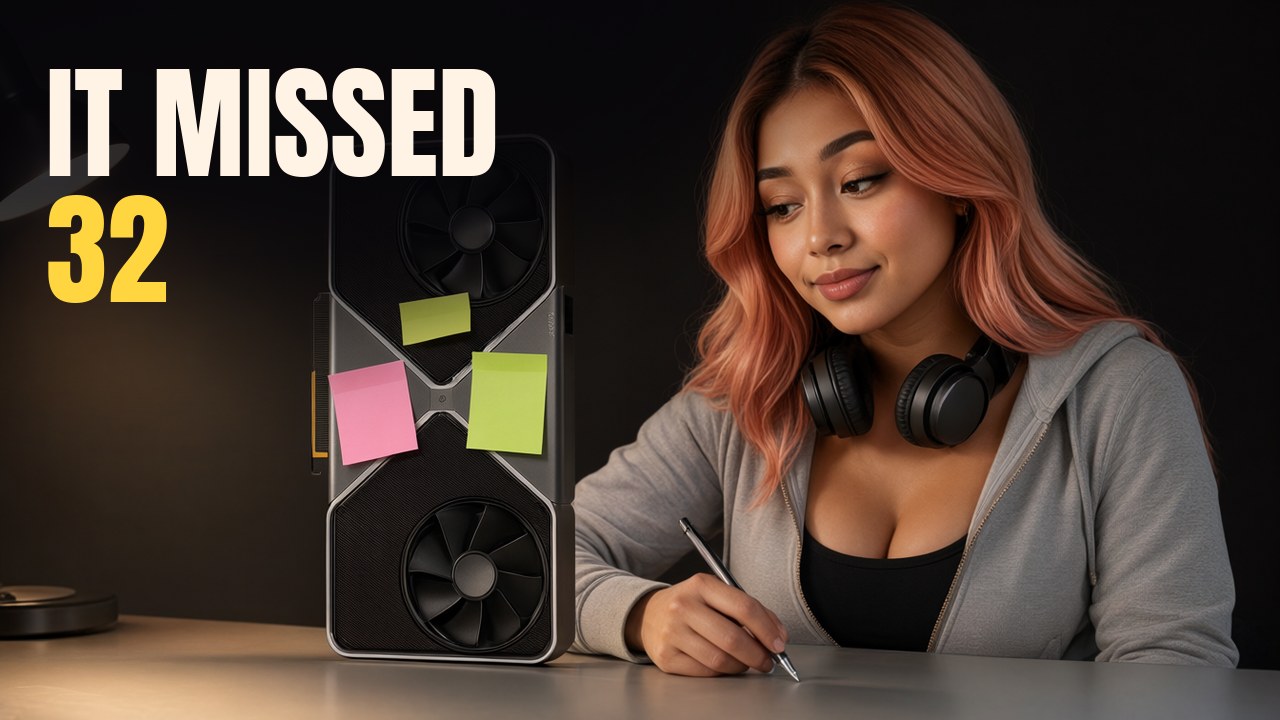
Arm 2: Claude after the free seats. The “after” plan in the receipt: her hand peels the yellow note off the card, no pen, MISSED 32 IDEAS.
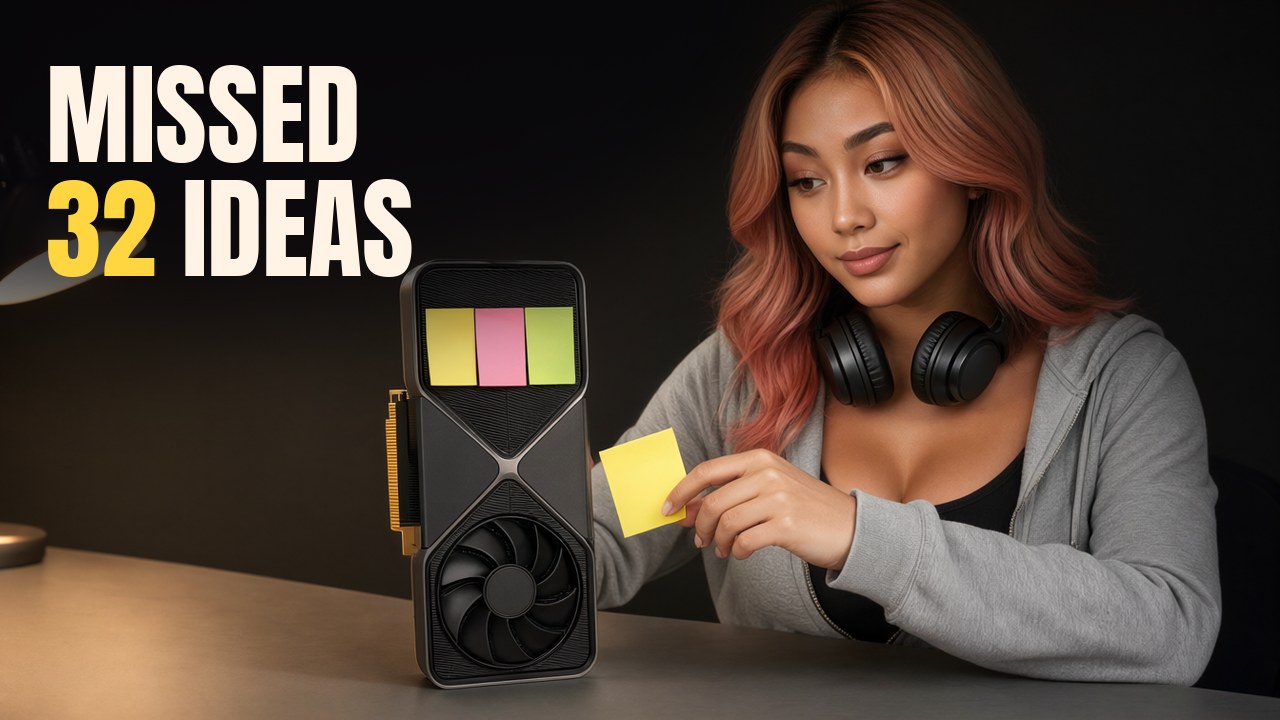
Arm 3: free models only. No paid seat at all. Qwen 3.8 took the lead and the other free models told it what it missed.
Its first plan: the presenter over a glowing laptop holding a torn paper strip, MISSED IT. The other free seats (Gemma 4 26B, Qwen 3.6 27B, Gemma 4 12B) offered nine suggestions, all exact copies. The lead used two: the RTX 5090 now lies on the desk in front of the laptop and is the focal object. It refused three, among them THEY MISSED THIS and HIDDEN DATA FOUND. Local model time for this run: 581 seconds, most of it one cold load.
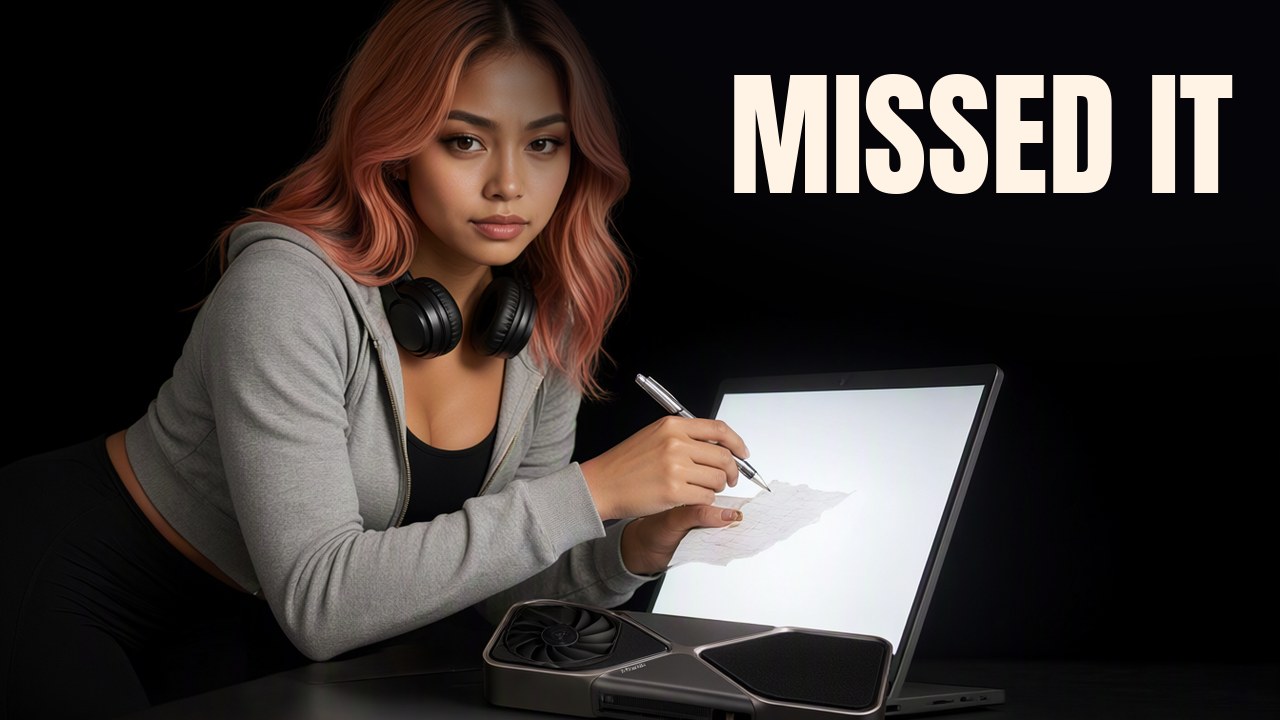
Picture recipe for all three: Qwen-Image 2.1 edit at 1344 by 768, the RTX 5090 product photo and two photos of the presenter as references, the arm’s own picture plan inside one fixed wrapper, seeds 5911 to 5914, one seed picked per arm by eye at phone size. Three of the twelve seeds drew her with dark hair because our wrapper repeated a wrong line from the brief; those were not picked.
Test & Compare
All three thumbnails go into Test & Compare, YouTube’s own tool for testing thumbnails. It shows each one to different viewers and picks by watch time share. YouTube says that can take up to two weeks.
We said our three lines before anyone knew:
- If Claude’s own picture wins, the council cost us 22 minutes and changed nothing that mattered here.
- If the revised one wins, that is one test on one video.
- If the free one wins, you may not need the paid seat for this job.
Result: not in yet.
What we checked in three finished works
One thumbnail test shows very little, so we went back through work we had already published. We checked three of our committee’s 54 runs, read from files: our song We Aren’t There Yet, its music video, and our tutorial on making an AI music video at home. Every saved plan records which seat gave which idea.
| what | count |
|---|---|
| ideas credited to the free models | 68 |
| already in Claude’s own first plan, in whole or in part | 36 |
| new | 32 |
| of the 32, reached the finished work | 20 (9 as written, 11 changed) |
| of the 32, dropped | 8 |
| of the 32, cannot tell from the files | 4 |
| of the 32, named in the producer’s recorded praise | 0 |
| of the 32, named in the producer’s recorded criticism | 2 |
That 32 is the number on the thumbnail.
What reached the finished work: a line in the published song, “we’re running on borrowed time and second-hand wires”, came from a free model and Claude’s draft did not have it. In the tutorial, Claude’s first plan put 24 lessons on air. All three free models said ten, and it shipped with ten.
The other side: one free model’s thumbnail idea for that tutorial was rejected by the producer and left out of the test. The second criticism is linked to a free model’s idea by inference, not by a quote.
A correction to our own record: we used to credit a free model with our favourite idea in the music video, an old PC as her coach. It was in Claude’s first plan all along, and Claude then cut it down. The free model argued to keep it, and the producer chose the full version.
The limits. This is three runs, read from saved files. The music video was not watched again for the check. Nobody has made these works a second time without the committee, so we cannot say they came out better. We can only show what changed in the plans and what reached the screen.
Failures we hit
- The 22 minutes. The dry run took 122 seconds. The on-screen run took 1,317, because of cold loads from a slow disk.
- One model call failed with HTTP 500 (Gemma 4, on its critique). The script retried it and it passed.
- Two strips were not exact copies. The Qwen 3.6 seat first offered strips of 14 and 15 words, over the 12-word limit. On the retry, two of its three strips still did not match the pitch they named. The script kept them and marked them.
- Claude went over the cap. Its first revise answer was 3 to 10 characters over 600 on each pitch. The script refused it and Claude resent.
- One credit is wrong. Claude credits the words “Her hand holds” to letter R for two subtasks. For one of them, those words are not in R’s pitch for that subtask. The receipt marks it NO. The script does not refuse it. This is the known weakness: the lead’s “words taken” are not validated.
- All three free models pitched the same scene, her at a glowing laptop.
- Our own committee agreed with Claude almost every time. Claude’s plan became the base 298 times out of 299. That is why this script has no vote.
Not tested by us
- Any graphics card other than one RTX 5090 with 32 GB. That covers every card under 24 GB. The kit’s README has an example cast for smaller cards, marked NOT RUN BY US.
- ChatGPT or Gemini as the lead.
- The plain
qwen3.6:27btag in the on-screen run. - Mac or Linux, or any Python other than 3.14.
- Any decision other than creative ones. Ours were a thumbnail, a song, a music video and a tutorial.
- Karpathy’s
llm-council, or any of the other council programs.
Reported, not ours
These come from other people. We did not test them.
- The cloud council’s design (answer alone, rank with names hidden, a chairman writes the reply; four paid cloud models through OpenRouter): from the
llm-councilproject page by Andrej Karpathy, https://github.com/karpathy/llm-council. - About twenty cents for one answer from a council of paid cloud models: the figure given in Jason Cooperson’s YouTube guide “Your AI is LYING to you. Build an LLM Council Instead”. Their number, not ours.
- Published tests on debate.
- “The Cost of Consensus: Isolated Self-Correction Prevails Over Unguided Homogeneous Multi-Agent Debate” (Bertalanic and Fortuna, ACM CAIS 2026) tested ten copies of the same small model. It reports that debate used 2.1 to 3.4 times the tokens of one model correcting itself, for equal or lower accuracy.
- “Stop Overvaluing Multi-Agent Debate” (arXiv 2502.08788) reports that debate often loses to simple single-model methods, and its authors say different models in the room help. This is where the advice to pick free models from different families than your lead comes from.
- “Talk Isn’t Always Cheap” (arXiv 2509.05396) reports that a weak member can pull a strong one below what it scores alone.
- We read the two arXiv papers as search summaries, not the papers themselves.
- One video test of a cloud council: Prompt Engineering, “Does LLM Council/Fusion Actually Work?”. As reported there, the council won one of three question types.
Those tests are about answering questions that have an answer key. Ours are creative decisions with no answer key, different models, and no vote. None of that is proof that ours works.
Download
Download the kit: council.py, casts.json, README.md, AGENT.md, TEN_QUESTIONS.md and the example folder with our on-screen run.
Free to use, change and share. Attribution requested: please link back to this page.
The file has a seat for the AI you already use and three seats for the free ones on your PC. It has no seat for the person who decides. That seat is yours.