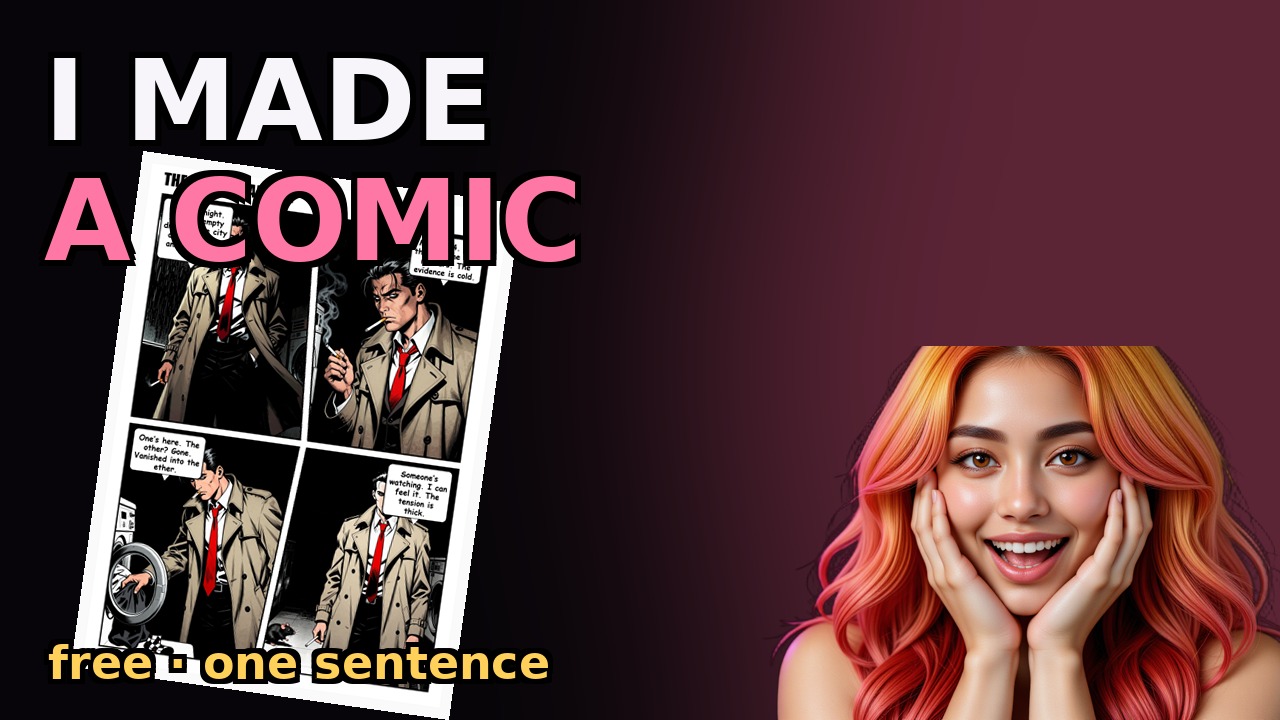
The companion episode: Engine Room, the comic studio.
A comic is the friendliest thing you can make with AI. It’s built from the two things AI is genuinely good at, a picture that holds still, and a few words, and none of the things it’s bad at. No video to drift, no voice to lip-sync, no thirty frames a second to keep from falling apart. Every panel is a single, finished image: it either looks right, or you roll it again for a few seconds until it does.
The studio: three workers
- The writer, a local language model. You hand it one sentence; it returns a script: pages, panels, who’s in each shot, the dialogue, the sound effects.
- The artist, an image model (we use a fast local diffusion model in ComfyUI). It draws each panel, one at a time.
- The letterer, a small assembler that lays the panels on a page, draws the speech bubbles, drops the SFX, and hands you a finished comic file (PNG pages, or a CBZ).
Writer → artist → letterer. A two-page comic takes about two minutes of drawing. The crucial part: the writer stage is just text, so you read it and fix it before you spend any GPU. Edit the script. Then draw.
The one hard thing: consistency
This is the whole game, the same character has to be the same character in panel two, panel eight, and page four. AI’s instinct is to draw a brand-new stranger every single panel.
The fix is the oldest lesson in local AI: write it down and repeat it.
- A locked, detailed description of your character: the same words, in every panel prompt. Body, face, hair, outfit, colors.
- A fixed seed per character, so the dice land the same way twice.
Describe a character loosely and trust the model, and they’ll change their hairstyle between panels like they’re late for something. Lock the description, and a noir detective stays the same man across eight panels.
Style is a costume
Same story, same characters, same pipeline, change one word and you get a completely different comic: manga (screentone, speed lines), noir (heavy shadows, one red accent), euro-album (clean line), sunday-strip (bright cartoon), even painted realism.
One real lesson from the tour: flat, drawn styles hold a character together far better than photo-realism. Realism has too many ways to be slightly wrong (the same reason AI video drifts). A cartoon compresses a person into a few repeatable shapes. Want your hero rock-solid across a hundred panels? Lean stylized.
The seams (and the fix)
| It does this | Do this |
|---|---|
| cartoon styles shrink adults into toddlers | frame the shot waist-up |
| the model is literal (“heats food” → drew a washing machine) | name the exact object |
| realism drifts | lean stylized |
| speech bubbles land on faces | dock them tall and narrow in the corners |
None are dealbreakers. They’re seams, and a comic where you know the seams is a comic you can finish.
The pipeline is three commands
script (writer) → panels (artist) → assemble (letterer). Simple enough to hand to an agent. But the quality is won in the edit: read the script, lock your characters, then draw. That last part: the taste, the locking, the editing, is the human job.
The tool is open source: github.com/AskAillex/comic-maker: one Python file, MIT licensed, with example pages and the exact consistency technique from this guide baked in. It’s early and it will keep developing (the bubble-corner fix from the episode is already in); issues and comic pages equally welcome.
Watch the full build on YouTube → @AskAillex. Made a comic? Show it at r/aillex.